2020 Cook County Property Tax Analysis — sort of

image credit: Andy Arthur CC BY 2.0

We have a new report from Cook County Treasurer Maria Pappas, subtitled “2020 Cook County property tax analysis: A heavier burden for businesses, Black and Latino suburban property owners.”   It’s got more detail than I recall seeing published before, including two decades of total real estate tax revenue countywide and by triad, and (for the past two years only) median taxes per parcel for residential and commercial, by municipality and township (and limited data for Chicago wards)  as well as a fun list of the ten highest residential and commercial tax bills for each township. The extra load Cook County’s current classification system places on commercial property is noted.

All of this data for individual parcels has been available on the Treasurer’s web site for some time, but it wasn’t assembled for convenient use.

It’s likely impossible to discuss the real estate tax system (let alone the complete scope of public revenue) in a way which can hold the attention even of people who find themselves heavily burdened by the way government is funded and operated.  And Pappas’ office got this information out quickly, as the taxes have only recently been calculated and won’t be due until October 1.  All the same, there are problems which one hopes will be fixed next time this is done (and one certainly hopes there will be a next time, soon.)

Noting the continuing rise in revenues, the report asserts that “[t]he bigger tax burden is not being shared equally.”  What could this mean?  What would be equal?  Should we fund government by a poll tax, which is the only way to get everyone to pay the same amount? Perhaps the writer means “equitably,”  a desirable thing tho difficult to agree on. It’s then observed that “Property owners in many south suburbs continue to pay far more in taxes than landowners in other parts of the county.”  I will set aside the fact that “property” and “land” aren’t the same thing, and assume that the writer may have meant “real estate taxes are higher in many south suburbs than in other parts of the county,” which is sufficiently cautious that it must be true.

But in fact the amount of real estate tax paid by a median homeowner is much lower, less than $4,000/year in Bloom and Thornton townships (page 49 of the statistics section of the report), less than any of the north suburban townships (page 56).

That doesn’t mean that the taxes in Bloom and Thornton aren’t a burden for many, because taxes imposed on struggling people are always a burden. And the very high tax rates reduce market values, while increasing the extra burden on renters (who cannot benefit from the “homeowner exemption.”)

The report makes no attempt to separate the value of land from the value of improvements, even tho the assessments provide this breakout for each parcel.  There’s no distinction between owner-occupied and renter-occupied homes. The only mention of vacant land is to say that it’s been ignored, as has mixed-use (residential+commercial) property.  There’s no mention at all of exempt government-owned land.

It would be helpful to include reference maps, especially of townships. And in an ideal world, the tables would be offered in spreadsheet format.
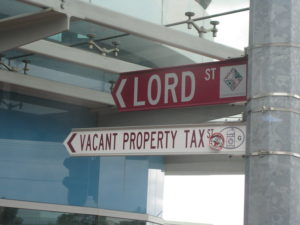

 

Sun-Times report inadvertently helps show the benefits of simple LVT as a revenue source

Image credit: Purple Wyrm CC BY-NC-SA 2.0

According to a Sun-Times report, Cook County Assessor Fritz Kaegi acknowledges that his “Senior Freeze” program, under which old property owners claiming household income under $65,000 can get a big break on property taxes, is “riddled with errors.” Highlighted is a multi-million dollar condo in Water Tower Place, whose owners pay only $2502/year.  While it’s certainly possible that these folks might have income under $65,000/year, that seems unlikely, as they also own a Florida condo valued at over $1 million. Their Chicago property apparently also benefits from the temporary removal of toilets during a 2017 remodeling.   It seems that the Assessor never noted that the toilets were replaced (or perhaps they were not?)

While the WTP property is clearly an extreme case, the senior freeze program transferred $250 million from owners of 144,904 properties who participate in it to the remainder of the 1.77 million taxable properties (of which 1.6 million are residential) in the County.  With the total property tax revenue at $15.6 billion, this amounts to about 1.6 % of total taxes collected.  The Sun-Times article provides several other examples of affluent old people who benefit from the program.

Clearly this is a problem of bad policies ((discriminating against renters, the nonelderly, and people who find it difficult to complete simple bureaucratic forms), and taxing improvements), combined with governmental malfunction (Kaegi hasn’t been able to get the program under control, partly because there is no mechanism for the County to verify incomes).

It should not be necessary to mention, but I will mention anyway, that the Sun-Times report relied on property tax data being, for the most part, publicly available.  While far worse scandals likely could be found regarding income tax, many of these can’t be documented unless taxpayers “voluntarily” release their information, or it is (probably unlawfully) liberated.

Clobbering fairness more accurately

Where fairness comes from: Cook County Board Pres. Toni Preckwinkle; Illinois House Speaker Michael Madigan (credit: WBEZ CC BY-NC 2.0 and Wikipedia)

We have a new North Suburban Reassessment Report from Assessor Fritz Kaegi. As a “reformer,” this Assessor publishes a lot more information than his predecessors.  In fact, he publishes all the code for his assessment models.

Accurate assessments are said to be important because assessing a property too high can “destroy wealth by diminishing the market value of the property.”  Which is true, but do not taxes based on accurate assessments also destroy wealth?  What the Assessor seems to mean by a “fair” assessment is an assessment that is calculated in accordance with applicable laws and ordinances.  This definition of “fair” comes mainly from our friends in the Legislature and County Board, with some role for other government officials. “Fair” in Cook County means that owners of houses or vacant land should pay taxes at 40% of the rate applied to ordinary industrial or commercial property, unless special favors have been bestowed.  In the rest of the State, “fairness” requires rates in the absence of special favors to be uniform. In all areas, “fairness” requires that religious and most nonprofit educational facilities are entirely exempt from tax. Continue reading Clobbering fairness more accurately

There is no mystery…

Ships Abandoned in Yerba Buena Cove San Francisco during the California Gold Rush 1849 (public domain image from Wikimedia)

…as to the cause which so suddenly and so largely raised wages in California in 1849, and in Australia in 1852. It was the discovery of the placer mines in unappropriated land to which labor was free that raised the wages of cooks in San Francisco restaurants to $500 a month, and left ships to rot in the harbor without officers or crew until their owners would consent to pay rates that in any other part of the globe seemed fabulous.

                              …Henry George; Progress & Poverty Book V Chapter 2

George goes on to describe how gold mining was organized, and why it was the form of tenure rather than just the availability of gold that raised wages:

[I]t was by common consent declared that this gold-bearing land should remain common property, of which no one might take more than he could reasonably use, or hold for a longer time than he continued to use it. This perception of natural justice was acquiesced in by the General Government and the Courts, and while placer mining remained of importance, no attempt was made to overrule this reversion to primitive ideas. The title to the land remained in the government, and no individual could acquire more than a possessory claim. The miners in each district fixed the amount of ground an individual could take and the amount of work that must be done to constitute use. If this work were not done, any one could relocate the ground. Thus, no one was allowed to forestall or to lock up natural resources. Labor was acknowledged as the creator of wealth, was given a free field, and secured in its reward.

— Progress & Poverty, Book V, Chapter 2

And now I tripped over a 2002 paper (From Commons to Claims: Property Rights in the California Gold Rush by Andrea G McDowell) that provides a lot of detail and background supporting George’s assertion. A particular mining claim might be 100 to 900 square feet. A miner would work it for a few weeks, then expect to move on to another one.  Thus the first miners to arrive had an incentive to avoid land monopoly, because they’d be looking for land again in a short while. “[The miners’] position can be summed up as a rejection of a fee-simple interest in mining claims on the grounds that this would result in the monopoly of the diggings by capitalists and the exclusion of individual miners from the chance to strike it rich.”

There’s a lot about how various mining districts managed their operations — certainly not all the same and often poorly documented, with a lot of the information coming from personal journals and correspondence rather than official sources.


More failure of CTA to collect its earnings

CTA Holiday Train
2006 version of the Holiday Train at Belmont —                    Image credit: Tony CC BY-NC-ND 2.0

I recall a couple years ago, the first time I saw the CTA Holiday Train enter a station.  It was packed, mainly with grandparents/aunts/uncles/cousins taking small ones for a ride.  Probably generated a lot of revenue. Forward to 2020, a train crowded with people who breathe isn’t desired, so what to do?

Well, they could have just cancelled it, but that’d be dropping yet another tradition, and I suppose reducing overtime for union employees.  So they’re going to run it empty, and instead of crowding the train, folks can crowd the platforms– probably a bit less close breathing.

But CTA trains run every day with people on them– the problem is the crowding. Why not sell tickets? How much would people pay for a ride in a semi-private car, restricted to, say 10 people per car? $25 for a 2-hour trip? $100? I don’t know, but it’s nontrivial.  Maybe $1000/trip/car, $4000/trip/train, $160,000 assuming each space is sold just twice per operating day.  Now, $160,000 is probably not quite enough to operate one bus for a year.  But why not collect it?

Ideally, CTA would use the money to pay the cost of operation, and apply any left over to its growing deficit.  But it might be more acceptable to have some sufficiently progressive charitable organization– United Way?– devise a system for distributing the proceeds to a politically-balanced array of groups actually assisting impoverished people.  CTA could even reserve a certain number of tickets for actual impoverished folks who’d like to ride.

I wonder how much money a lobbyist could attract if paid $160,000?

How many deaths did the Covid response cause?

image credit: Tyler Merbler (CC BY 2.0)

Thanks to Center Square via Wirepoints  for alerting me to a (weekly?) mortality tally from the CDC. It provides weekly counts of death by underlying natural cause, for each state.  For Illinois, unredacted Covid-19 deaths started with the week ending March 21, and the report covers the 22 weeks thru August 15.  Counts for 2019 as well as 2020 are shown.  My tally below attributes to Covid those deaths where it is an “underlying cause.”

             Covid      All other     Total

Year 2019             N A                       43,223                  43,223

Year 2020            6,779                     46,537                  53,316

So if I am interpreting this correctly, we seem to have had 46,537-43,223=3314 excess deaths, not due to Covid, but possibly due to the plandemic lockdown measures.  Given that most Covid victims had co-morbities, which might for some have proved fatal without Covid, this figure must be an understatement. Further, if some excess deaths are due to people not getting routine screening or treatment during the lockdown, those might not show up until some time hence.

Not the first daylight robbery, but a good one

I’ve long considered Dominic Frisby, perhaps the only working comic who’s also a financial writer, to be a Georgist.  Several years ago he posted a nice video explaining the land value tax.  Now he’s gone deep into a history of taxation and its effects, in  Daylight Robbery: How Tax Shaped Our Past and Will Change Our Future   Readable and succinct, but somehow by the end Frisby has forgot about his video.

The title is appropriate, so good that over a dozen older books already carry it, but the subtitle may be unique.  Frisby asserts quite a few facts new to me, and for the most part provides references (altho some are a bit summary, showing only the domain name such as cbs.com, or time.com, where one might need to search around a bit).

The book starts with the story of Hong Kong, a British colony which prospered thru free markets and lower taxes (The point stands, even tho in recent years external demand pushed housing costs to obscene levels, and in recent months political and governmental interference made conditions even more difficult.) Going thru tax history, Frisby of course discusses the effects of the window tax (“daylight robbery”), and explains why it was considered to be fairer and easier to administer than its predecessor. He tells us about tax revolts and England’s first income tax, all records of which were apparently destroyed (source citation is a two-volume history that I can find only in Latin).  He explains the cause of the U S War between the States (which Lincoln waged more for revenue purposes than in any opposition to slavery.)  He notes that Hitler was tax-exempt, and the Guardian used a Cayman Islands entity to (apparently legally) avoid taxes.

After lots more stories about taxation and its role in history, moving to modern times, Frisby explains (as if any of us need to know) the burden that taxation of productive activity places on people trying to, well, be productive. He talks about the digital nomads and crypto currencies which make collection of production tax more difficult, and about digital transactions which make the collection easier.

Finally he proposes a Utopian tax system.  Is it collection of all economic rent as the sole source of public revenue?  Not really.  He wants VAT (not to exceed 15%, and including narcotics) and income tax (also not to exceed 15%).  So the record-keeping burdens and complexities of those will remain, tho perhaps a bit reduced because the impact of error is less.  To these he wants to add L U T (Location Usage Tax), which is basically LVT but with perhaps a clearer name, and which would be set at some percentage of the land rental value.  He wants voters to choose the percentage, apparently a single rate nationwide. And since he aims to keep governmental expenditures below 15% of GDP, it’s unclear that there would be any L U T at all.

“The location usage tax does not apply just to land, but to any asset granted by nature — the airspace the mineral wealth, and even the broadcast spectrums.”  He doesn’t seem to have any problem with private collection of rent for “intellectual property,” even tho I P is a privilege granted and protected by the government, thus straightforward to track and assess– if there’s any justification for I P at all.

It seems that much of the land in Britain is “unregistered,” in that the owner isn’t known, and in Utopia this will be remedied by identifying every  owner.  I’m not sure why that’s necessary.  A tax bill could be posted for each parcel, and a copy mailed to the owner should s/he request it.  After due and repeated notice, If the bill isn’t paid, the land could be taken over by the Crown (or whatever they call it over there), and auctioned to somebody willing to pay the tax. (If nobody’s willing to pay the tax, it needs to be reduced.)

Would I like to live in Frisby’s Utopia? Well, of course here in the U S we have no VAT, and the retail sales tax is generally less than 15%. But income tax can be higher, and we have various other taxes which Frisby proposes to eliminate.  And LVT has other benefits in addition to the revenue it generates.  So on the whole, it’s a better deal, a step in the right direction. But Utopia? Go back and watch the video.

(Note: This review is of the 2019 edition of the book.  The Publisher’s web site indicates that a new edition will be released later in 2020.)

Having no expertise in epidemiology nor politics…

…I still feel qualified to express opinions regarding COVID-19

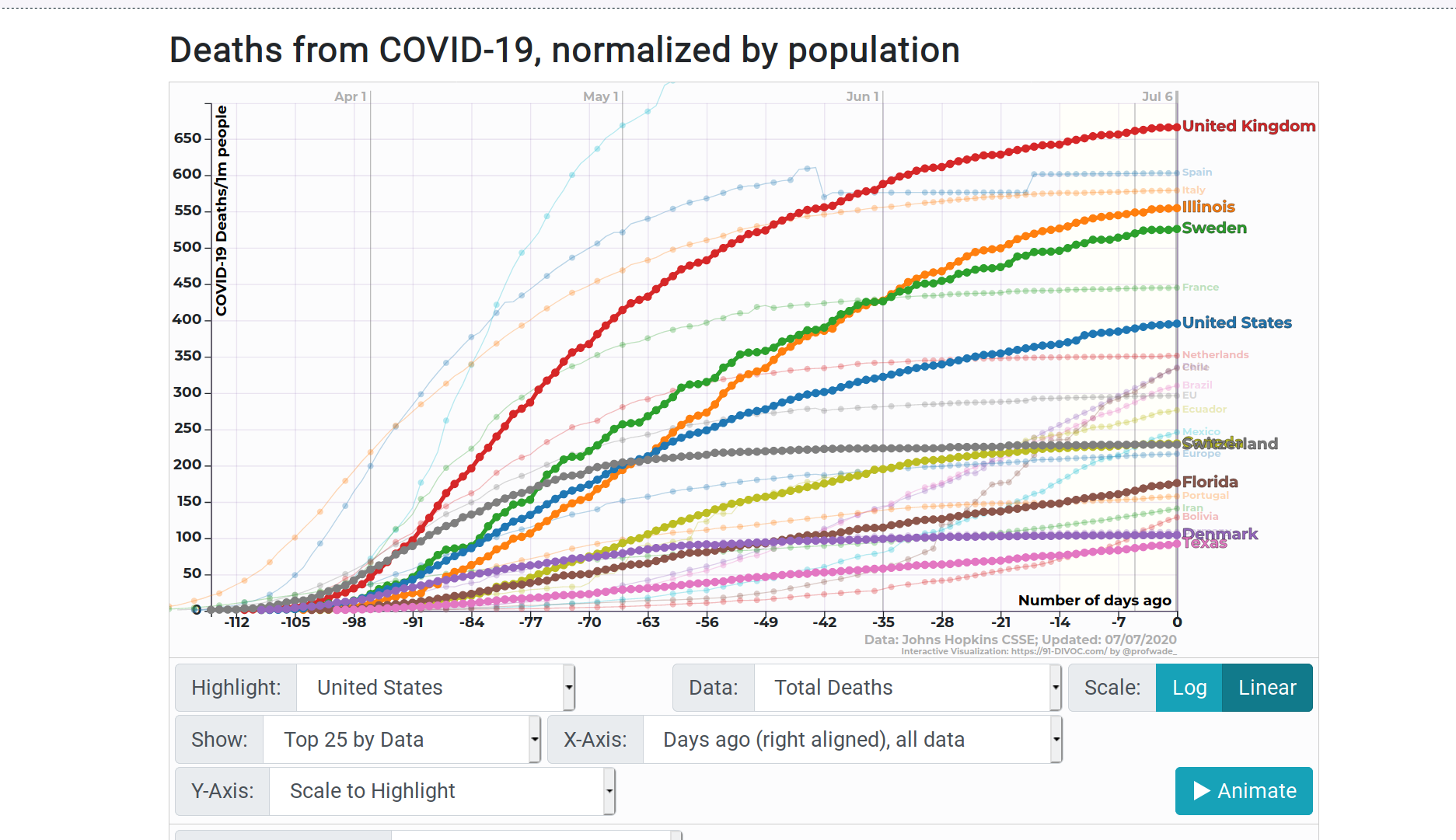
Here’s a chart from the excellent 91-divoc site:

(The country you can’t see, overwritten by Switzerland, is Canada.)  What I make of this is that maybe the Swedish approach, relatively unrestricted, works about as well as the Illinois approach, pretty locked down except for big demonstrations. Otoh, if the Danes are similar to Swedes, then the former nation’s lockdown might have been quite helpful in reducing deaths.  To a level almost as low as Texas, tho we’ll see how that works out in the coming month or so.

Go play with the site, recently enhanced to allow comparisons between U S states and nations.  It’s great fun.

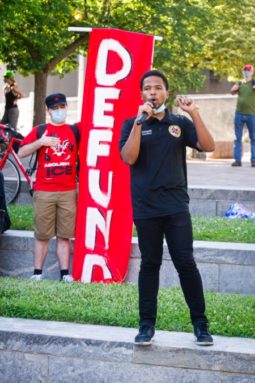
Who should be defunded?

Image credit: Rodney Choice/Choice Photography (CC BY-NC-SA 2.0)

I was only a bit surprised to find that Chicago’s 2020 police budget is $1,778,002,408, or $660 for each of the 2,693,976 folks that DJ Trump’s Census Bureau estimates live in Chicago.  This doesn’t include $737.5 million for the police pension fund, nor $204,867,834 for the Office of Emergency Mgt and Communications, nor $135 million for “judgments and settlements against the City,” (including but not limited to police misbehavior), nor the police-related portion of the City’s capital budget, which seems to include the “joint public safety training academy” ($85 million, but just $15.75 million in the current year), and some other facilities.  All told, and without doing the detailed analysis which I wish the Civic Federation would do, it seems the the City spends something like $1000/person/year for police.  That doesn’t necessarily mean that police should be defunded in whole or in part; after all, reported crime has for the most part been declining, so perhaps we are getting something for our money. But it gives some idea of the dollars involved. (And it turns out that, as I was writing this, the Civic Federation produced a post covering much the same ground, with better context and detail and colorful charts, and noting that I failed to include some undetermined but substantial benefit costs among the cost of police.)

Compare police costs to Chicago Public Schools.  CPS is a separate unit of government, but controlled by the Mayor and funded mainly by Chicago property tax payers.  For the current year, it’s planning to spend $7.84 billion, or $2910 per Chicago resident.  Enrollment continues to decline, 13% in ten years (roughly the same amount as reported crime, but that might just be a coincidence).

Summing the police and school expenses, Chicago spends $3910/person.  For the hypothetical family of four, that’s over $15,000.  I wonder how many two-worker households would prefer to have one stay home, help educate the children, hiring tutors as needed, and keep an eye on the neighborhood, if their income increased by that amount.  Just a thought.

Update September 27:  It turns out I’m not the only one suggesting that we spend too much on government schools.