[I]n Bill Clinton’s encapsulation of political strategy, “It’s the economy, stupid.” But the success of an economy can only be measured by its growth. Since growth requires the accelerated consumption of limited natural resources, it is not a sustainable model in the long run.
If you concentrate on how a place is owned, however, the perspective changes. As this book demonstrates, matters of laws, of rights and of politics become crucial, taking precedence over economics. From that point of view… “It’s the neighborhood, stupid.”
…Around the world and throughout history, neighborhoods have succeeded in a million different ways. It all depends on how the earth is owned.
That, the conclusion of Andro Linklater’sOwning the Earth, illustrates what is right and what is wrong with the book. Our quality of life does does depend on how the earth is owned, and Georgists are aware of the importance and practicality of recognizing each individual’s right to what no one produced. But must a sound economy necessarily use more of the earth’s limited resources? Is there no practical way to use resources more efficiently? And is there no possibility that economic improvement could be measured by anything other than economic growth?
The book is wide-ranging and (mostly) well-written, making connections in place after place between how the right to use nature is recognized, and how well the community developed. It draws some connections that I hadn’t seen before, such as how the growth in mortgages on American farms followed logically from the end of homesteading.
And Linklater does devote a couple of pages to Henry George, but seriously misunderstands why George’s proposals weren’t widely adopted, saying “[I]t is notoriously difficult to arrive at a valuation system that can clearly separate earned from unearned capital appreciation.” Here he means “separate improvement value from land value,” and he is wrong. Practical methods of doing so on a mass basis were described back in 1970 in TRED #5 (outline), which is not posted on line to my knowledge, and in this more recent paper by Ted Gwartney, MAI. And, of course, land values are routinely estimated by appraisers and are a component of almost every U S income tax return that involves commercial or investment real estate.
It is true that, with limited exceptions, George’s proposals weren’t adopted, but for a different reason. Mason Gaffney has provided a compelling and well-sourced explanation (also available in a book), and it is unfortunate that Linklater seems to have been unaware of it. One wonders what else he did not know.
March 1 2015 update: I just discovered that Ed Dodson has produced a more thoughtful and detailed review of Linklater’s book.
One way to pay involves value capture — establishing special taxing areas that assume that development like a new road benefits landowners by growth in sales, rents or property values, he said.
“I’m a developer,” Ranney said. “I think developers need to pay more for the value that is generated (by the project). Value capture makes sense. That is something that the real estate community isn’t too keen on — but let’s get real. If you use public dollars to generate private wealth, you can darn well pay for it.”
And an observation regarding transit progress in the region:
Noting he takes the same train from Libertyville that his father took, Ranney added that “nowhere else in the world do they have complacency about exactly the same level of service.”
In order to fund community needs from a tax on land value, assessors need to estimate what that land value is. Conceptually the task need not be difficult (Ted Gwartney outlines some options here, but a more complete and still-valid examination is in this book.) Basically, you look at sales prices for actual land transactions, and make adjustments for parcels which haven’t sold recently or where land comprises only a small part of the value. But what happens if the buyer pays something additional, “off the books,” for the land?
According to Peter Katz, that seems to be what often happens. This presentation at APA last March starts off slow (and self-promotional), but moves along thru some interesting territory. Regarding the price of vacant land, he asserts that, in many desirable areas, developers have to first buy (or option) the land, then negotiate with local authorities to get permission to build. Getting that permission might require agreeing to donate money (or land) for public use, or perhaps less savory expenditures, and to the developer this is part of the cost of land. If an area of any size is subject to such constraints, all the land sales are below market prices by the amount of such costs, and all sites, whether sold or not, receive assessed land values that are lower than what developers actually pay to get a buildable site. This results in less public revenue, implying a need for other taxes, as well as a tendency to develop at lower densities than might be appropriate, when developers choose to settle for existing zoning rather than what they might be able to negotiate. Katz suggests that a formal study of this effect should be done, and nominates Lincoln Institute to make it happen.
Katz’s remedy seems to be a combination of form-based zoning codes, plus a sophisticated (and presumably accurate) fiscal impact analysis that might show denser development to actually be more “profitable” to governments. But, responding to a question about 65 minutes into (and near the end of) his talk, he acknowledges that funding government from a land value tax would be a good way to obtain the desired development pattern, and that Henry George was a great guy. His observation that Georgists tend to be wacky has been made before, and I can’t say it’s wrong.
I was wondering a few weeks ago why Revolution Brewing supported the lobbyist-friendly “Transit Future” funding effort. How foolish I was, is not brewing a regulated industry desirous of government favors? WBEZ reminds us of the “Small Brew Act,” which would cut the federal taxes on the first 60,000 barrels produced. Senator Kirk, who has never done anything constructive that I can recall, toured the Lobbyist Revolution Brewery and spoke kindly of the act.
Of course, there is no just reason to impose any tax on production of beer or anything else people want, provided that land rent is collected by and for the benefit of the community. In the same situation, I might do the same thing Revolution has done, especially if I knew more about political strategy and good beer than about smart fiscal policy and public finance. But it’s a shame they’re doing it.
Over here in Illinois a coalition of powerful and dangerous people and organizations seems to be supporting a “transit future” initiative to harvest a “robust revenue stream,” inferentially a further increase in the sales tax. I say “seems to be” because I haven’t verified that everyone listed (including southern California’s moveLA) is in fact a supporter rather than a typo. And “inferentially” because the examples cited on the site involve sales tax increases.
An informed review by political economist Ed Dodson of Tim Howard’s new book about the collapse of Fannie Mae. The senior people understood that they were in trouble due to politics and ideology, and they saw the collapse of underwriting standards, but most had no interest in addressing the fundamental cause.
I am not going to call it “Obamacare” since most of it existed long before we’d heard of that guy, and I am not going to call it “health insurance” since it only applies to medical costs, which have just an approximate relationship to health, and it is not insurance since it is intended to pay routine costs rather than help pay for catastrophes. I suppose I might call it “diversion of productive people’s income to lobbyists and their clients” (which we might pronounce “DOPPILC”), but I’ll just call it “govcare” since it certainly involves the government and has something to do with care.
I really don’t understand it at all. Do we, the People of the United States, wish to pay whatever is necessary in order that all of us may have whatever medical treatment a group of licensed professionals assert is necessary? If so, why do we think it will not absorb 100% of our production beyond subsistence? If not, how do we decide priorities and set limits, when inevitably any limit is going to find someone very sick and very sympathy-arousing unable to afford some treatment which really would be helpful? (The answer probably has something to do with us the People of the United States behaving like adults, but if I was the very sick person in question I might have a different attitude.)
The subject is simply too big for me to comprehend, so I will just nibble around the edges. Today’s nibble is a message I received from the “health insurance” company who take a large part of my income.
Copayments do not apply to deductible or out of pocket.
Or, to put it a different way, if you purchase any considerable amount of medical treatment, what comes out of your pocket is likely to exceed the “out of pocket limit” that “your” “insurance” company proclaims. (This is in addition, of course, to the amount they already took from you to provide what they call “coverage.”
New York’s housing situation (image credit: David Shankbone (cc) via flickr)
Melissa Kite had a piece in Thursday’s Guardian complaining about the escalating cost of London housing. She starts off well, observing that she can’t earn as much in a year as the increase in the value of her flat. “[W]hat does it say about our society when we can, in theory at least, make more money doing nothing than we can by the sweat of our brow?” Agreed, it’s a problem. So what does she recommend?
In New York, 45% of people live in rent-stabilised accommodation where landlords are limited to increasing rates by a certain percentage each year. This is not rent control – which accounts for only 1% of tenants – but rent with controlled increases, an important difference.
I will wait to hear from New Yorkers about how this has solved their housing problem. Going back to the Guardian article, Kite gets pretty close when she observes that “a British company is selling a flat-pack self-assembly ‘house in a box.’ But she doesn’t take the next step to ask: “If you buy one, where are you going to place it?” The answer, of course, will be that anyone who can afford only the flat-pack house will be unable to obtain a suitable site anywhere near London.
The problem isn’t house costs, it’s land costs. And land costs would be a lot lower if all land was subject to a stiff site value tax, because there could be little or no speculative premium. (To be clear, the cost of obtaining a site for your house, purchase financing plus tax, would be much less if landholders weren’t pricing sites based on their future hopes rather than current usefulness.) This point is readily made, for example here and here. It’s unfortunate that the writer of the Guardian article seems unfamiliar with the concept.
It’s well-understood, I guess, that Google tracks and filter-bubbles those who search with it. And Microsoft is, well, it’s Microsoft, no reason to suppose they’re not tracking and bubbling users also. Fortunately, there are alternatives:
Great options for search! So what if I want to advertise? And suppose that the people I want to reach are the kind of people who would prefer these privacy-facilitating search options? They’re profit-seeking companies and they carry ads. Can I buy ads on them?
Not really. It turns out that Startpage has an arrangement with Google, so I would need to buy Google Adwords and hope, maybe, that they’ll end up on Startpage. With Duck, the arrangement is with the “Yahoo-Microsoft Search Alliance” and seems otherwise similar.
This may be the best way for a small company to get a tiny piece of the search pie, but depending on your competitor doesn’t seem like a great long-term strategy. Maybe they have other plans. But for now, there seems to be no way for an advertiser to reach privacy-minded users, except by taking advantage of the tracking that the dominant search companies do.
Last year the remnant of the Chicago Tribune requested ideas for elements of a new “Plan of Chicago.” They even posted a few of the responses on their site. I suppose some were included in the hardcopy newspaper too. But those don’t seem to have included my submission, so I probably ought to post it here.
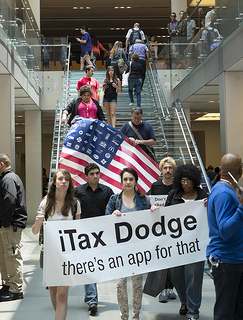
My proposal, of course, relates to how public revenue is raised. The protesters pictured on the right probably wouldn’t realize that it relates to their concerns, and would almost certainly cause Apple to make a greater contribution to local coffers than they do now. But it wouldn’t increase any corporate tax rate nor prevent Apple from playing accounting games. It doesn’t need to.