Using gifts to promote thought about taxes

As Tolstoy pointed out in slightly different words, anyone who understands the fundamentals of public finance cannot fail to agree that the smartest way to fund our governments is to collect economic rent. So the challenge for Georgists is simply to get the 99% of the population who really don’t think about these things to do so.

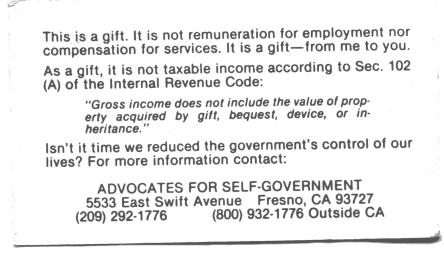
Which brings to mind some cards printed many many years ago by Advocates for Self Government.

front
front
back
back. The phone numbers and addresses may no longer have any connection to the organization, because the card is probably over 30 years old.


The idea is, of course, that if you like (or respect or admire) the person who served you, you don’t tip, but give a gift. A gift to an individual is taxable to the giver, not the recipient, but as long as you don’t give any one person more than $14,000 you won’t pay gift tax. (I get my information from Wikipedia, which is no more likely to be incorrect than other sources I know of.) I find tipping disconcerting,  but I do admire and respect the ability of many  baristas, waiters, cabdrivers, barbers, etc who have skills I could never hope to develop.  I like some of them too, and have had a few of them as students learning the fundamentals of political economy.

So this is an approach Georgists might try, to encourage more folks to think about important issues, while making their lives just a teeny bit easier.  No, I have no idea what happens if you put a card and a small amount of money in a tip jar. Maybe new regulations will be issued requiring separate gift jars, and auditors dispatched to assure compliance..
Residency requirements….

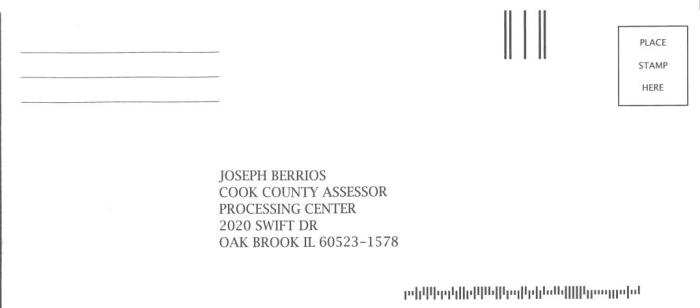
envelope1When the dinky suburb I live in decided to outsource the water bill processing to a firm six towns distant, I didn’t really object.  Maybe it’s more efficient to have the work done elsewhere.  But when the Cook County Assessor asked me to send a form to an address just outside the county boundary, I wonder what message he is trying to send.



NY Times reports another benefit of the citizens dividend

photo credit: coal dubya via flickr (cc)

If the earth belongs to the people, then whatever is paid for the use thereof belongs to them in some equitable fashion also.  Therefore, beyond what’s needed for legitimate government purposes, there would seem to be enough for a considerable “citizen’s dividend” for everyone.  Plenty of discussion on this subject can be found here.

My guess is that it would likely be enough to replace most of the aid programs which provide funds — rarely enough but maybe better than nothing — to low income people.  One advantage is that it could be administered at relatively modest expense.  A related advantage is that it can probably be made to work, with everyone getting what they’re entitled to. This latter aspect is what came to mind when I read this NY Times article, in which a Georgetown law professor summarizes “a litany of automation and contracting meltdowns” whereby the poor were unable to obtain benefits to which they were entitled under various aid programs and which may have been essential to their support.

His point seems to be that, while healthcare.gov suffered major problems initially, it was soon repaired because its failure affected many non-poor people. (I have no idea how well-repaired it might be, but will assume he is correct about this.)  He does not mention the citizens dividend, perhaps is unaware of it, or maybe ignores it because it would likely reduce the demand for lawyers. But he makes the case. A regular check for everyone, as a just entitlement, would be a far simpler system than most of the means-tested (and otherwise-restricted) aid programs which cost taxpayers so much money.

And while we’re on the subject of means-tested programs, consider this:

[I]f a single mother has two children in childcare and she’s making $36,000, she’ll pay about $310 a month for childcare. Then, if she gets a raise to $37,000, she’ll need to pay $1,200 a month for childcare because of the loss of a subsidy.

Of course, it needn’t be a raise, it might just be a decision to work a bit of overtime. I have written about this before and I will probably have to write about it again. Means-tested aid is a disgrace.


Progressive proposal from Kenya

detail from photo by Jennifer Wu via flickr (cc)

Writing in Standard Digital, Charles Kanjama proposes that “If government was clever, it would include a value-capture approach in project financing.”  He’s writing about big infrastructure projects, which in his time (2014) and place (Kenya) include railway and port improvements. He suggests that perhaps half the cost should come from land value tax, without explaining why it would be appropriate for landowners to receive half the benefit of improvements paid for by the general community.  (Kanjama is an attorney and accountant who was rated among the top 100 legal minds in Kenya as well as one of the 100 most influential people in that country.)

The same edition (January 4 2014) carries another article showing a problem resulting from failure of the community to collect all the rent.  It seems that the government wanted to remove a large number of squatters who had settled in a protected forest.  Ordered to vacate, they each received 400,000 shillings ($4604.67 US, according to Wolfram Alpha) to purchase land elsewhere.  Now the time for relocation has expired, and many spent the money on things other than land.  Of course I don’t know these people, don’t know what land was available, don’t know their needs, but very clearly if land were nearly free (as results from a high land value tax) they would almost certainly be better off.

More propaganda I am too slothful to review

Graffito image by Horia Varlan (cc) via flickr

A new report “Copyright Industries in the U S Economy” has been released by the IIPA (A conspiracy of seven associations of copyprivilege holders).  I should read and review it, but I could not do a better job than Mike Masnick, so read his review and the comments thereon.  Of course, IIPA and its members probably have several staff and/or automatons, whose duties include responding to constructive comments. Fortunately, they get responded to in turn.

Like the man said

“In order to preserve and enhance jobs, exports and economic contributions, it is critical that we have strong legal protections for U.S. creativity and innovation in the U.S. and abroad.”

Which means creators need to be free to create, with strong legal protection against those who would try to prevent their use of ideas which may have been touched by others.

What cell towers might be worth

Water tower on Plymouth Court in downtown Chicago.  Photo by Menaceofprivilege 2013.
Water tower on Plymouth Court. Photo by Menaceofprivilege 2013.

I just happened on this article from Reuters (via Yahoo),  reporting that AT&T has long-tem leased or sold 9700 cell towers for what appears to be $500,000 each, including a leaseback of each at $1900/month with 2% annual escalation.  Lots of details aren’t included, but it gives some idea of what an old water tower or other (possibly disused) elevated location in an urban area can be worth. Curious why there don’t appear to be any antennas on the downtown Chicago tower pictured here; perhaps they’re on the other side.

Getting back to blogging — just in time for football

Football Cake by Sweet Pea 0613 via flickr(cc)

After a couple of months’ diversions, I hope I am getting back to something like regular blogging, starting with a nice article — as far as it goes, at least– by Gregg Easterbrook about the subsidies and political favors governments provide for professional football. A lot of this, on stadium subsidies (not just for football), has been covered in the past by Heartland, most recently here (pdf). But Easterbrook covers some additional ground, noting the federal favors done for the football business. I hadn’t been aware that NFL has a special anti-trust exemption (I thought it was just one of the many many cases where feds choose not to enforce laws.) And I’d never made the connection between stadiums paid for by the public, and the “intellectual” “property” of football game images, which of course are government-created privilege.

Easterbrook does seem to be a football fan, which is a skill (affliction?) far beyond my capabilities.  My preferred remedy for “sports” subsidies has always been for the audience to go away and do something else.  But even tho I’m just as happy watching an amateur softball game, many people evidently get pleasure from seeing the professionals in action.  Easterbrook suggests that it’s necessary that “public attitudes change.”  Great idea, but as long as the public feel compelled to watch these games, it’s difficult to imagine any politician willing to risk the wrath of those who control them.

Land value depends on the definition

Image of Drake Hotel by Teemu008 (cc via flickr)

In an urban context, absent special environmental issues or legal constraints,  land value and location value are pretty much the same thing.  So we read in Crains that the Drake Hotel is on a 63,000 square foot parcel valued at $150 million, implying this land is worth about $2381/square foot.  But no, the location probably isn’t worth that much.  Rather, the land is leased by the owner of the structure, and the lease document says that, every five years, the land value is to be estimated and the annual rental set at 10% of the land value.

Possibly 10% was a reasonable return in the past, but in today’s zero-interest-rate world no safe investment would yield that much. Rather, the owner of the land actually owns two things: (1) the land, and (2) the privilege of requiring the building owner to pay an above-market rental rate.  Were we to value the land “as vacant,” which is the correct way to estimate land value for taxation purposes, then (2) would disappear and the land would be worth, more or less, the same per square foot as other land in the very prestigious immediate neighborhood.

It would be interesting to see what the lease says specifically about how the land value is to be estimated, and to read the (certainly confidential) document describing how the $150 million value is justified.

For more discussion about methods of valuing land for assessment purposes, duck around for works by Ted Gwartney on the subject, or consult the old but still-relevant TRED volume.

Location remains critical, even as the criteria change

image credit: xeni via flickr (cc)

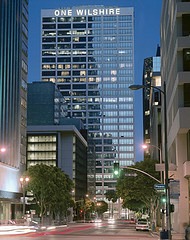
The Internet doesn’t make the earth economically flat.  Some locations are still worth many times as much as others.  But technology can affect the criteria for “most valuable site,” as most recently illustrated by the sale of One Wilshire Blvd in Los Angeles for more than twice the price per square foot of a mostly similar office building nearby. It also commands about twice the rent, per square foot.

The difference: One Wilshire is ” the primary terminus for major fiber-optic cable routes between Asia and North America,” and is therefore is a location prized by telecommunications firms.

“You can’t reproduce the connectivity,” said real estate broker Kevin Shannon of CBRE Group Inc. “It’s telecom gold.”

Of course the buyer thinks it’s a fine investment that will only become more valuable in the future.  Presumably the seller thinks different.  The only thing certain is that technology will change, and the pattern of valuable sites will likely be affected.

GMO crops don’t even increase yield


image credit: Stuart Williams via flickr (cc)

Here’s a program note from ABC indicating that yield of GMO crops is no greater than conventional crops.  Unfortunately there is no formal citation of the source article, nor is it available on line as far as I can tell, and ABC tends to remove their program notes after a few weeks.  However, the article, from the International Journal of Agricultural Sustainability, was written by Professor Jack Heinemann of the University of Canterbury in New Zealand, which might be enough information to locate it. Heinemann’s web page links to an article which may even be the one in question.