I am back, recovered from an attack not by privilege

based on image by: William Wilkinson via flickr (cc)

This blog disappeared on February 3, and returns today February 17 2013.

The reason is a strangeness at my former host, whose ordinary practice is to evict customers from time to time, without warning or appeal, when servers become overloaded. I had heard about this from other victims before I signed up, frankly didn’t credit those reports, but it is true.  I have no reason to think I generated a lot of load, but have no access to the account to see.  What’s strange is, if I was running a budget host, and one of my customers, who was only paying less than $1/week, generated a lot of traffic, I would suspend the account and send the customer a message: “If you want to retain your account with us you must upgrade to a more expensive plan.” No such message was received or referenced.

I can’t blame privilege for this, as the hosting market seems to be quite competitive, and I see no evidence that the deceptive practices of some hosting companies are protected by government.

As it happens, I am at a new host, and I am paying more than previously but not outrageously so.  Another difference between the old host and the new one is that here we have a fairly active user discussion board, where even prospective customers are able to participate.  Otoh, transition to the old host was much smoother, whereas moving here involved several discontinuities, which caused delays despite prompt attention from tech support.

I am not naming my old host right now, for two reasons.  First, I remain responsible for another site over there, which hasn’t (yet?) been evicted. Second, other than evicting me without notice, the old host was quite cooperative about sending me a backup file and redirecting nameservers. (A refund has been promised; we shall see about that.)


Another way to liberate books

empty card catalog
image credit: andresmh via flickr (cc)

While the logical way to make most books conveniently available to more people is to greatly reduce the scope and duration of the copy-prevention privilege known as “copyright,” another approach is to buy books their freedom, one-by-one. This seems to be the approach of Unglue.it.  They use a crowd-funding approach to pay privilege-holders for a creative-commons license, which essentially makes the book available to all if enough people are willing to donate enough money.  Certainly better than nothing and perhaps it will prove fruitful.

To date they seem to have ransomed three books in this way, tho their web site doesn’t tell us how much they paid, with four ongoing campaigns seeking to raise between $1,000 and $25,000.

Fighting nature with sheep

photo by AuntOwee via flickr (cc)

The problem, according to Science Daily, is that marginal pastureland in the Swiss Alps, after 8 centuries, is being abandoned and given back to nature.  So what does nature do? She grows green alder, which by increasing evaporated water causes a decrease in runoff feeding streams. These streams feed hydroelectric generators, and thus the reduced flow, in one valley alone, will cost something like 500,000 to 1,000,000 Swiss francs annually.  The alder also “contaminates the water with nitrates,”  tho the article doesn’t explain how this is a problem.

The remedy? Researchers demonstrated that Engadine sheep will peel the bark off the alder, killing them and [presumably] restoring grassland.  But “the added financial value of sustainable land use is not sufficient to keep the arable land open.”

Which raises the interesting question: Which poor country has a sheep-raising tradition and potential emigrants who might like to move to Switzerland?

Lobbyist vs. Lobbyist: How Chicago enterprise works.

Photo credit: Adam Greenfield via flickr (cc)

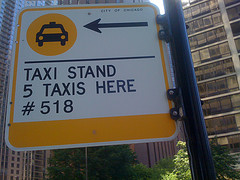
Earlier this week the Tribune carried a pretty good report on Chicago’s Uber vs. cab situation. Altho many of us transit-dependent mundanes may have missed the story, it seems that people who can afford cabs can also afford smartphones (or can text using dumb phones), and many of them prefer Uber as a way to get service without having to speak with a person. You can choose a taxi at regular taxi rates (but with a minimum 20% “gratuity” that the driver splits with Uber and the credit card processor), or a classier vehicle for considerably higher cost.  I am surprised that folks pay such high rates to avoid dealing with traditional taxi companies.  A few years ago I learned that, for those who pre-book and travel more than about ten miles, limousine service is likely to be much cheaper (even for a person traveling alone) than a conventional taxi; I suspect this is still the case.

Naturally, owners of medallions (and existing dispatch services) don’t particularly like this idea, so both sides are trying to improve their service to entice more customers have hired lobbyists to “persuade” the investment banker/politician who holds the Mayoralty to throw things their way.

I guess I’m surprised too that medallion prices are holding at high levels (most recent median price $345,000, up from $260,000 about a year before, based on data compiled by Chicago Dispatcher). Whether this is really an open market, or perhaps subject to manipulation by major owners, or another symptom of financial repression, I have no knowledge.

Of course Uber’s pickup zone doesn’t encompass the entire city of Chicago, missing much of the south side, but it does extend service beyond the City boundary into some relatively affluent suburbs.


Another report ignores the citizens dividend

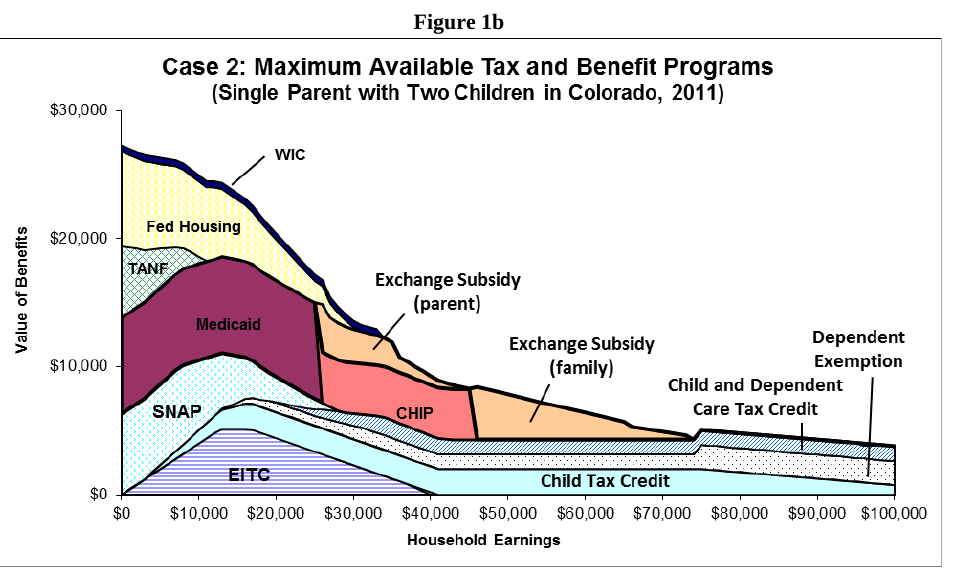
marginal rate chart
From C. Eugene Steuerle’s June 27, 2012 statement at http://www.urban.org/UploadedPDF/901508-Marginal-Tax-Rates-Work-and-the-Nations-Real-Tax-System.pdf

I’ve written before about the wild effects of graduated taxes and means-tested benefits which can dump low-income workers into effective tax brackets in excess of 100%.  That is, once the effects on eligibility for earned income tax credit, child tax credit, medicaid, SNAP (food stamps), subsidized housing, and so forth are taken into account, an extra $1000 of income can easily cost more than that amount in increased taxes plus reduced benefits.  (Worse, most low-income people don’t have professional accountants who keep track of this, and so they don’t know in advance what the effects of getting a raise, or taking some overtime, might be.)

This is hardly original with me, and most recently the Congressional Budget Office has issued a report on the subject, summarized here by Evan Soltas of  Bloomberg. What can be done to fix this?  Not much, conclude most writers including Soltas.  We need tax revenue, we need to target aid to those with the greatest need, we can’t expect the rich to pay everything (since they have the lobbyists, lawyers and accountants to limit the taxes they pay.)

None of the writers who get attention seem to consider the citizens dividend. The basic idea is that government collects all the land rent — that is, the effective rental value of private control of natural resources — and share it with all citizens, everyone getting an equal share. It’s done on a small scale in several jurisdictions, including Alaska where each state resident gets a thousand dollars or so, each year, as a share of investments funded by mineral resources.  Of course, natural resources include not only oil, gas, and ore, but also the electromagnetic spectrum, agricultural land, forests, and much of the value of land sites (except of course those which have no market value.)  Suppose this rental value, or just a substantial part of it, were collected by the federal government and distributed, equally, to every U S citizen (maybe legal permanent residents should get a share also). How much would that be?  Would it be enough to pretty much replace most means-tested programs?  Wouldn’t that solve our problem?

Of course, arguments for collecting economic rent go far beyond fixing the screwed-up incentives of means-tested programs and graduated income taxes,  (visit a Henry George School or the Henry George Institute to learn more), but let’s not forget this benefit.

And by the way, it isn’t only the poor who can face these >100% marginal rates.  I wrote before about how certain Cook County homeowners with incomes in the $75,000 – $100,000 could face such rates; I don’t know whether these limits remain in effect. More broadly, it seems that affluent Americans subject to Medicare face a similar situation: As explained here, should your “modified adjusted gross income” amount to $107,001, then your Medicare cost will be $754.80 more than if your income had been only $107,000.  The effective tax rate on that particular dollar is 75,480%.  (Of course if you have a really alert accountant keeping track of all your financial affairs, she will alert you and find a way to avoid that extra dollar. And that accountant knows that the rates quoted above are for 2011 income, at least I think they are, and different limits will be in effect for the current year.)


Curious land tenure arrangement at Glencoe

photo detail of a former theater building on Belmont, by Terence Faircloth via flickr (cc)

As reported yesterday by Chris Jones of the Tribune, Writers’ Theater is planning a new $30 million home on the site of the Glencoe Women’s Library Club.  Being ignorant of things theatrical, I find the interesting part of Jones’ article to be

The building would rise on the Tudor Court site of the Glencoe Woman’s Library Club, which, unusually, would continue to own the land after its building was demolished. Writers’ Theatre would be granted a 99-year lease, with a rent of $1 a year.

Construction of buildings on leased land isn’t all that uncommon, and 99 years is a typical term. But at a rent of $1/year, this obviously isn’t an investment decision.  And as (presumably) a nonprofit association, neither the Club’s members nor their heirs can expect to benefit from an increase in the selling price of land by the year 2111.  The now-unborn who will be members of the club at that time might benefit, but it’s hard to imagine current members thinking that way.

So there must be something else involved.  Perhaps the Theater will be obligated to provide some space to the club, or perhaps the land title is encumbered so that it cannot be donated. Probably if we had all the information we’d find some implications for elaborate income tax trusts of some kind that were advantageous to someone in the past. Hopefully someone will come up with more information.

Jones also notes that the location is “not far from the Metra/Union Pacific train tracks,” which implies that theatergoers could ride Metra to and from performances.  Perhaps, if they’re lucky as to where they live and when the show ends, but the Metra service is sparse and nighttime connecting bus service essentially nil in the north suburbs. Patrons who dine in any restaurant or bar before or after the show will have the opportunity, however, to pay some of the costs of providing the uncoordinated, inconvenient service.

Are subsidies driving Chicago land prices back up?

Image linked from the Crain’s article

Of course they are, but it’s convenient to see it illustrated as Crains Chicago Real Estate Daily explains.

The proposal seems to be for Pam Gleichman and Karl Norberg to sell their 4.9 acre parcel (the Tribune story says 3.67 acres) near McCormick Place, in pieces, for a total of $195 million, which works out to something over $900/square foot, a level which I don’t recall seeing so distant from the loop.  We also learn from Crains that $90 million in TIF (real estate tax) money will be sought to help pay for these developments.  And of course the entire McCormick Place complex benefits from the 1% tax which all restaurant patrons in the central portion of Chicago (as far north as Diversey and as far west as Ashland) pay, not to mention the basic urban services, such as fire protection, transit, and streets, which are funded from other taxes.  We’re all paying so Gleichman and Norberg can get their $195 million. It’s only slightly comforting to realize that their venture is in bankruptcy, and the only reason we get to see these details is because they’re part of a court filing.  But it seems that, if everything works out as they claim, they’ll get to keep a large portion of this money.

Just for fun, we can consider what would have happened under a land value tax.  If the land was taxed at something approaching its full economic rent, it would likely already be developed pretty fully because nobody could profit by holding it underused.  There would likely be no bankruptcy because nobody would have loaned money on land with a modest selling price.

Transaction taxes

photo credit: AutisticPsycho2 via Wikimedia (cc)

Proposals for a small tax on investment transactions seem to make some sense.  Ordinary investors, small or large, are likely to buy or sell a small percentage of their holdings each month or year, while high-frequency traders could turn over theirs dozens of times per day.  A tax of, say, 0.1% would hardly be noticed by investors, but could make high-frequency trading (HFT) unworkable.  If HFT helps destabilize financial markets, then taxing trades this way would raise some revenue while improving economic stability.

Though I don’t see such a tax as consistent with geoist principles, it seems a lot less damaging than many of the taxes we already face.  The problem is that it cannot be enforced.  Trades can always be done in some way “off the books,” probably legally but otherwise if necessary.  Since those who benefit from HFT also have resources to control relevant regulatory decisions, any such tax will have loopholes or other means to prevent effective enforcement.

Sure enough,

most investment banks offer significant UK traders “contracts-for-difference” which are contracts that precisely simulate equity ownership while circumventing UK taxes on transactions (“Stamp Duty”).

— J Doyne Farmer and Spyros Skouras
“An ecological perspective on the future of computer trading” (pdf)

 So what to do about HFT? If we consider what HFT deals in, which is largely securities issued by corporations, it may be appropriate to modify the privileges that government grants to corporations, in ways that would make HFT less damaging.

Dangers of China’s cities– and ours

photo credit: Beth Burdick via Flickr (cc)

China Daily’s article “Hidden Danger Hazards of Big City Living” is really an infrastructure and construction story.  Sinkholes open up and swallow people, sections of glass-walled buildings drop down and kill people, big cities flood.  Of course, pretty much the same things happen in Chicago:  The loop floods (tho the streets are spared); neighborhoods flood regularlywindows fall from buildings killing pedestrians; sinkholes swallow cars (tho not pedestrians, probably because we have so few pedestrians). Sure, it’s not an everyday occurrence, but China’s urban population is about 250 times Chicago’s, so it’s not surprising that more accidents happen.

The article quotes officials saying that coordination among infrastructure construction and maintenance actors is poor, as is the quality of construction and building inspection. Probably true, and surely in Chicago the inspectors are trustworthy and respected, and infrastructure work is usually well-coordinated.

What really does seem to be a difference is how long infrastructure is expected to last. The China Daily article says 1200 out of 5100 total km of Beijing sewers (possibly referring only to storm sewers) is “at least 30 years old, with some of it dating back six decades. This is typical for most cities, experts say.” One infers that Chinese sewers are expected to last only 30 years.  In Chicago by contrast, 1/4 of the water pipes is said to be over 100 years old,  apparently the age at which replacement is likely to be justified. Sewers are perhaps even older.  And I think this age profile is typical of mature American cities.


Value capture is different from collecting the land rent

Photo by Sean Munson via Flickr (cc)

Henry George phrased his main proposal in various ways, from “make land common property” to the more pragmatic “abolish all taxation save that upon land values.”  Certainly a land value tax is a practical way of capturing land rent, and to the extent land value figures in existing assessments and taxation we are already capturing some of it.

But it’s important to recognize that land value, or more properly the selling price of land,  is only a close relative, not an identical twin, to land rent. One difference is that selling price is affected by estimates of what the future rent will be.  And land selling price is much more directly affected by the cost and availability of credit than is land rent.  Use of credit, in turn means an opportunity for banksters to get involved, decreasing the likelihood of real public benefit from public investment.

Which brings us to the World Bank’s 2008 report on Unlocking land values to finance urban infrastructure.  This report really could be entitled “Worldwide Catalog of Methods More Complicated and Prone to Corruption than Collection of Land Rent, Which Could Be Used to Finance Some Infrastructure But More Importantly Involve Borrowing and Lending of Large Sums Which Is, After All, What The World Bank Does.” In addition to involving large loans, the outstanding feature of all of these methods is that none provide any resources for operation or maintenance, thus they can help bring about the need for new infrastructure in the not-too-distant future.