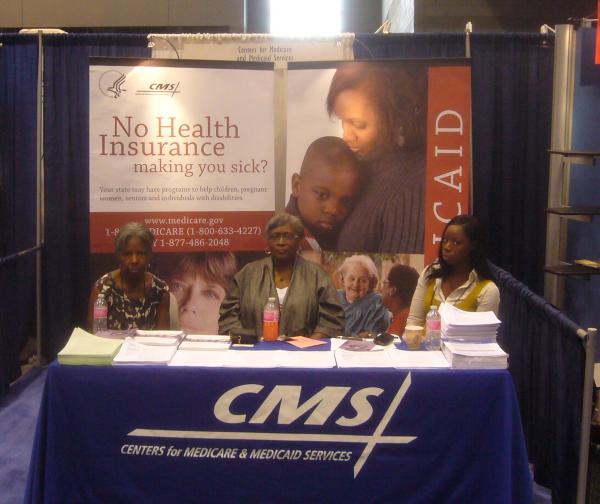
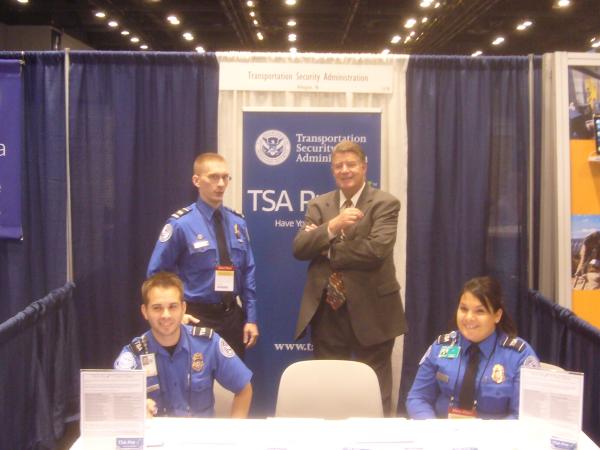
While assisting the Public Revenue Education Council at the National Council of State Legislators convention, I couldn’t help photographing some of the federal employees in “action.” Census was there, BEA was there, but I wouldn’t want to embarrass those guys because they sometimes do some useful things. We also had
Licensed Professional and Drug Patentholder Protection AdministrationOffice of Travel PreventionDepartment of Making Jobs and Workers Difficult to Find
Forgetting for a moment the impediment to commerce and free association, how much money are we spending on these guys? Thanks to Gannett’s Asbury Park Press (h/t Bob Matter), taxpayers can access a database of reasonably current salary information for most Federal employees. For state and local employees in Illinois, Wisconsin, Indiana, and Missouri, the Better Government Association has made similar information accessible.
Government employee pensions are also an issue, and Taxpayers United of America is building a database of this information.
Now, I’m not opposed to high salaries and liberal pensions. In fact, I think everyone should get them. The problem is not that government compensation is too high, but that private compensation is too low. Some clear graphs here (based on data collected by government employees) illustrate the problem. Nongovernmental American workers’ productivity continues to increase, but for forty years little or none of this has been reflected in wages. The best remedy involves displacing the rentiers.
*Payroller is a Chicago term for folks whose main function is to collect a government paycheck. It appears that in some places, the word has a different meaning.
Governments here in Illinois (and probably everywhere else) like to “request” things, but that doesn’t mean we mundanes always need to grant these requests. Two examples from recent experience:
detail from a photo by Chris Karr via flickr (cc)
Saving money: Illinois Secretary of State Certificate of Good Standing. Our high-tech sophisticated Secretary of State makes it easy, relatively, to get the “certificate of good standing” that organizations may require, for example, to set up some kinds of financial accounts. No problem, just go to Jesse White’s web site, do a search (which really works, in my experience), fill out the simple form and authorize a credit card charge of $16 ($5 transaction fee, $1 payment processor fee, and $10 expedited fee). But suppose you aren’t in a great hurry and don’t need (or want to pay for) expediting. Or suppose you lack a credit card but have a checking account (or can buy a money order). What to do?
Nowhere could I find the answer on Jesse’s web site. Fortunately, cheapness wonk Adam Kerman of the Transit Riders’ Authority knew what to do:
Write a letter to request the Certificate of Good Standing. Make sure to include the corporate file number and your contact phone number. $5 fee Secretary of State Business Services 501 S. Second St., Rm. 330 Springfield, IL 62756
And that’s just what I did. A week or so later, the certificate arrived.
Current RTA Executive Director
Saving Dignity: Regional Transportation Authority old person discount fare card. A good and privacy-minded friend of mine, having recently attained the age of 65, wanted to take advantage of the “reduced fares” available to old people (among others) on RTA-funded transit systems. First thing she found out was that it takes 3-4 weeks to get the required farecard, so she should have applied 21 days prior to her birthday. Too late for that, but she readily found the necessary form, which turns out to serve two functions: (a) apply for reduced fares based on age or other criteria; (b) apply for free fares based on likelihood of voting Democratic documented low income. Being successful enough not to qualify for (b), she still had to complete a form with a blank for “Social Security Number.” What do to?
She wrote “NOT REQUIRED” in the SSN blank, and 23 days later received a reduced fare card in the mail. Moral of this story: You can surrender somewhat less privacy than the authorities ask for, without giving up rights or privileges, at least in this case.
What’s this? No posts for a month? Actually had several things “almost ready” to post, but meanwhile I spent an interesting three days at the National Council of State Legislators’ “Legislative Summit,” what most of us would call their annual convention.
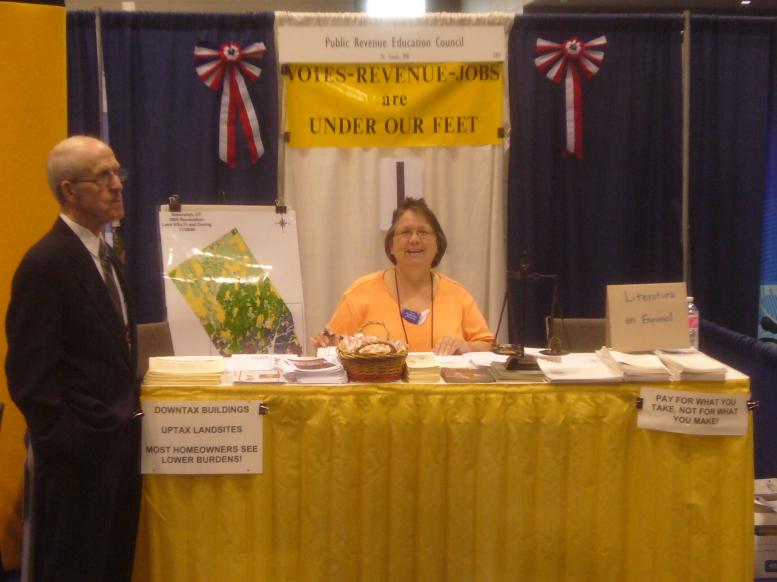
Since about 1996, the Public Revenue Education Council (Missouri chapter of Common Ground — USA) has staffed a booth at the NCSL conference exhibit hall, alerting legislators, their staffs, and other attendees to the existence of a tax option which generates revenue while increasing, rather than discouraging, productive economic activity. Honing the message over the years (and gaining seniority which allows choice of better locations within the exhibit hall), PREC President Al Katzenberger and his colleagues may have gained some ground.
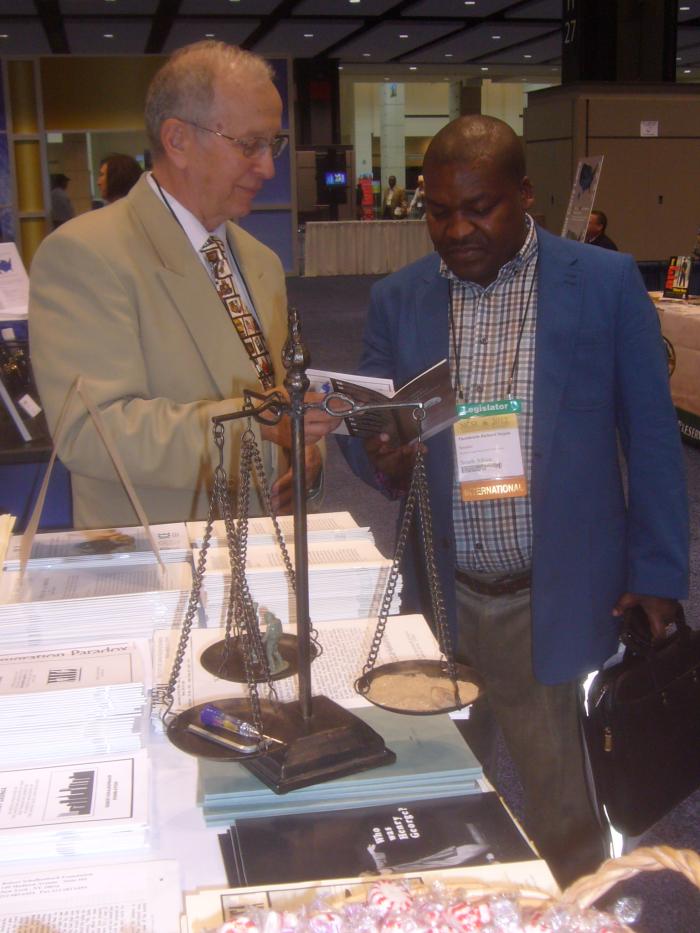
Al explains the economy to a visitor (All photos: Chuck Metalitz for the Henry George School)
Among Al’s innovations is a custom-made (and unpatented, as far as I know) three-tray scale, used to illustrate the factors of production. Land, labor, and capital (the trays) are all necessary for most production, and usually use money (the chains) to facilitate the process. Banks and other financial institutions (the arms holding the chains) may try to manipulate the system unfairly, and it’s the job of government (the central post) to keep things more or less in balance.
For the 2012 event, which concluded Aug 9, Al was assisted by Don Killoren of St. Louis, Irene Marmi of Chicago, and this blogger. Since two people are generally enough to staff the booth, each of us had time to wander the hall visiting with other exhibitors– and there were many (a list is here). Why so many? As has been said: “No one’s liberty or property is safe while the legislature is in session,” so everyone wants legislators to do, or refrain from doing, something. Some exhibitors were interesting, and might be the subject of future posts.
Of course each of us has a slightly different view of what geoists want to accomplish, but we tried to present a unified message: “If you tax jobs, retail sales, and buildings, you’re likely to get less of those. If you tax the value of land as vacant, you’ll get economic benefits and, hey, let me tell you about much nicer your community will look.”
Legislators can be a tough audience, but Al seems to hold this one’s attention
Few people might stop by a booth about public revenue, so Al and Don just call out to passers-by “Where are you from?” They reply, and Al or Don says “Oh, you could use this there.” But they’ve also learned (better than I) to just shut up and listen to each prospect, find out what their concerns are, and provide a helpful response.
Irene on duty, while Don scans for passing prospects
Thinking about next year’s NCSL conference (in Atlanta), we might want to seek a cleaner look by having fewer documents on the table. Plastic racks would be suitable for some of them. Others would be “under the counter,” or perhaps even available only on request via email. People will put their business cards in a fish bowl if a prize is offered. What prize? Maybe a $50 RSF gift certificate, along with some suggestions about what to spend it on. Use the business cards to generate an email list. Three days after the conference, everybody gets a “Thank you and call us if we can help” message. If they don’t respond, they won’t hear from us again until a week before the 2014 (Minnesota) conference, when we invite them to stop by our booth.
We need an attention-getting colorful postcard-size piece, highlighting our special web address which we’ll set up for the occasion, and perhaps a phone number. To the extent possible, the look of the documents we distribute should be modernized and made consistent. The Revenue Source is Under Our Feet seriously needs updating, and must include contacts for (not necessarily in) every state.
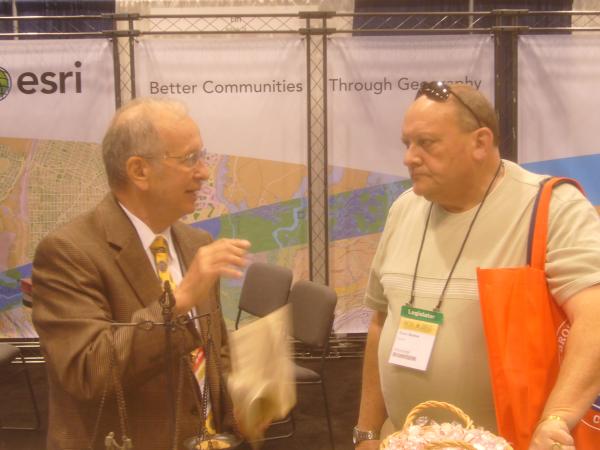
Across from the PREC booth was ESRI, the dominant geographic information systems software provider, who almost certainly were behind the Greenwich land value map we used to illustrate how straightforward land value assessment is. They suggested some contacts and ideas which may aid geoists in the future.
Good interview last week on EconTalk, with Enrico Moretti who has a new book, The New Geography of Jobs. Some places are growing and innovating, some stagnating and declining. Which one would you rather live in? Enrico seems to prefer the innovative one, where workers are more educated (at least in the credential sense), jobs are available, and even if you’re working in a local service job — barber, dentist, whatever — your wage will be higher. Host Russ Roberts keeps Moretti pretty much honest, sure wages will be higher but so will — they don’t dare use the phrase — economic rent. And so if you’re a homeowner, you benefit (assuming of course that you bought before the innovative, growing local economy was widely recognized), while if you’re a renter, perhaps not.
From the interview, it appears that the book includes some analysis of how working people benefit from low-cost imports and big-box stores. I don’t doubt it, if the working person can afford to support an auto-centric way of life then these developments do benefit her/his standard of living.
Moretti suggests that places will be better off if their workforce has more formal education. Roberts is at his best here, pointing out that, sure, college professors would say that. Moretti does seem to recognize that, as more people get credentialed (“skilled”), this will tend to reduce the earnings gap between the unskilled and the specialised. He does not say that it does so by reducing earnings of the skilled, but we can figure that out.
The most irritating part, for anyone who understands political economy, is the assertion that wages for service workers are higher in innovative, growing regions because service workers are more productive there. I don’t know if they’re more productive, maybe a dentist fixing the teeth of $100,000 engineers is more productive than one who does the same for $25,000 laborers, I have no idea. But regardless, wages aren’t determined by productivity. They’re determined by the alternatives: If the employer can get competent labor for less, she almost certainly will do so, over time if not right away. And if the worker can find a job that, all things considered, is more satisfactory, why wouldn’t he take it?
It’s all about the rent. Once you understand what it is and how it works, you’ll look for it and see it everywhere. You’ll know the fundamental cause of unemployment, low wages, economic stagnation, and poverty. The cause that makes possible most of the other corruption and theft that plague our nation.
The slogan came from a local campaign to reduce pedestrian deaths, certainly a worthy cause and one that got some funding and creative minds. But we should have thought of it first.
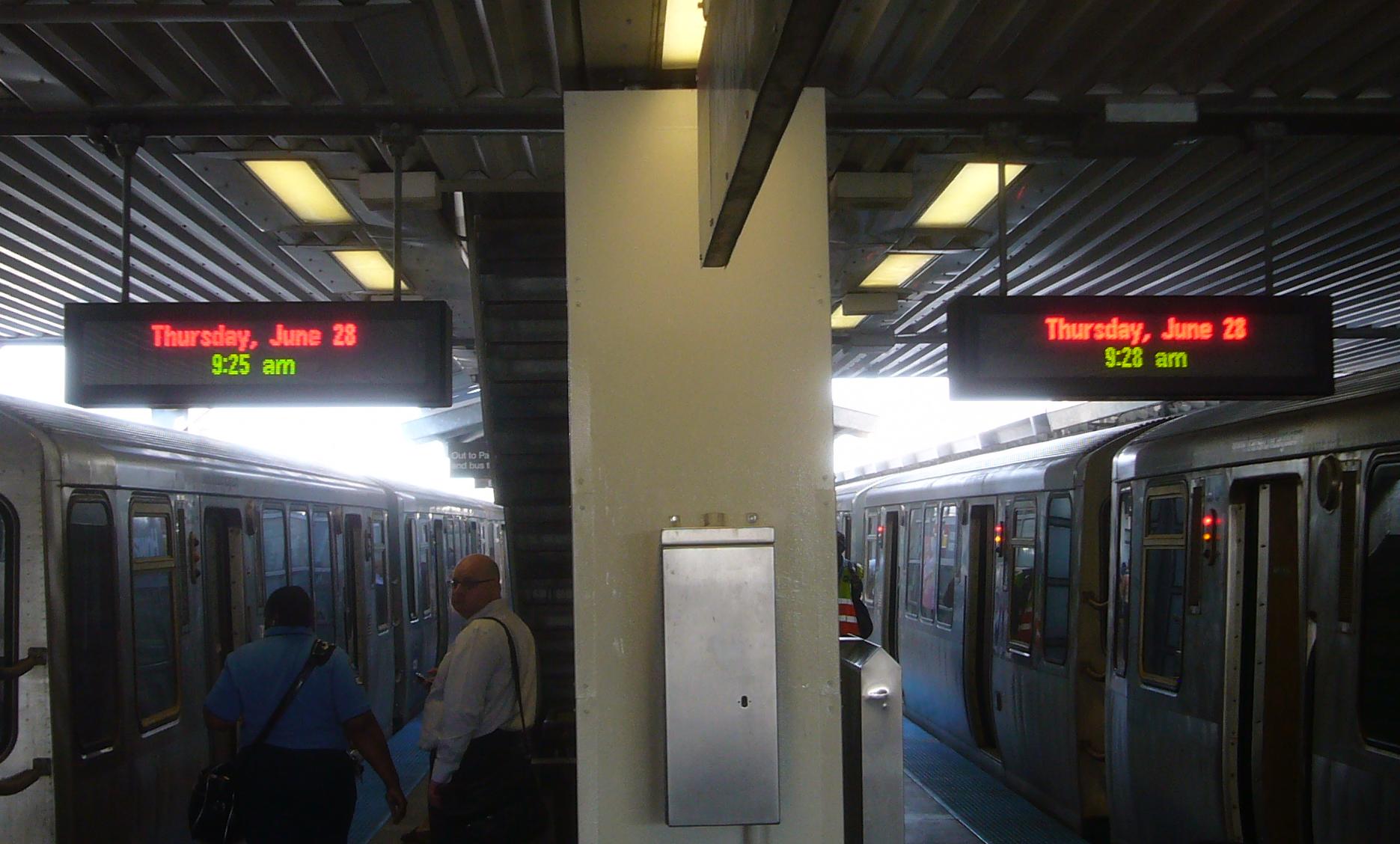
Tracks 1 and 2 at Howard Station (Transit Riders’ Authority photo)
The failure of the Chicago Transit Authority to coordinate its services is evident to regular riders. I have long attributed this to misplaced priorities, which seek to serve the interests of contractors, politicians, and certain employees, rather than passengers or the public in general.
But this picture implies that I’m wrong. CTA do a pretty poor job of facilitating convenient transfer from Yellow and Purple Line trains to Red Line trains at Howard Street, but this may have nothing to do with priorities or competence. Rather, the problem seems to be that Track 1 is in a different time zone from Track 2, so if passengers actually were able to transfer between trains on these two tracks they’d enter some sort of time warp, perhaps endangering their very existence and ability to pay taxes. Safety has always been CTA’s number one priority. (In the photo, both tracks are occupied by Red Line trains, so no transferring takes place. The practice of putting Red Line trains on both southbound tracks enables CTA to hold Yellow and Purple Line trains outside the station, preventing the dangerous practice of passengers transferring directly.)
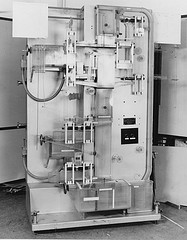
MONIAC at the London School of Economics (from Flickr Commons)
Yes, you can build an economic model without computers. In fact, around 1950 New Zealander Bill Phillips did, modelling economic flows not with electrons, but with water. He built a total of 14 of these “MONIACs”, one of which has been restored by Allan McRobie and can be seen in operation in this video. McRobie is a hydraulic engineer, not an economist; Phillips at first was neither, nor was he a plumber, but rather a journeyman electrician and polymath (eventually an economist at the London School of Economics). McRobie describes the machine’s operation in some detail. Like many economic models it fails to consider the role of land, but it does have a bucket representing optimism (perhaps Keynes’ “animal spirits”).
Phillips’ original design had an additional feature, a high-voltage connection that could be used to execute meddling politicians or bankers (see the video from about 17 to 19 minutes), but that has been removed in the restoration.
Like Henry George, Phillips smoked and died young, in 1975 .
“Debt” graffito photo by Franco Folini via flickr (cc)
When I see the same theme coming from two different sources, I think there’s a trend (tho maybe it just means I wasn’t paying attention). And so we heard Meredith Whitney a few days back describing the developing divide of local and state governments, between those that are solvent (and can attract mobile, affluent residents and investors) and those spiralling down the debt hole. Now Al Lewis looks at it from the retail side– nobody wants to invest where the mundanes live, but as areas like Silicon Valley and Washington continue to prosper retail facilities are renewed and enlarged.
In a democracy of educated, thinking citizens, any state finding itself on the wrong side of this divide could reverse its decline simply by removing all taxes on wages, capital, purchases, and transactions in general, substituting a very heavy tax on land value (which ideally would include the value of mortgages on land, to be paid by the mortgage lender rather than the borrower). Unfortunately, the “investors” who control much of the land in declining areas have the resources to fool the electorate, or can work directly with elected officials to prevent effective reform.
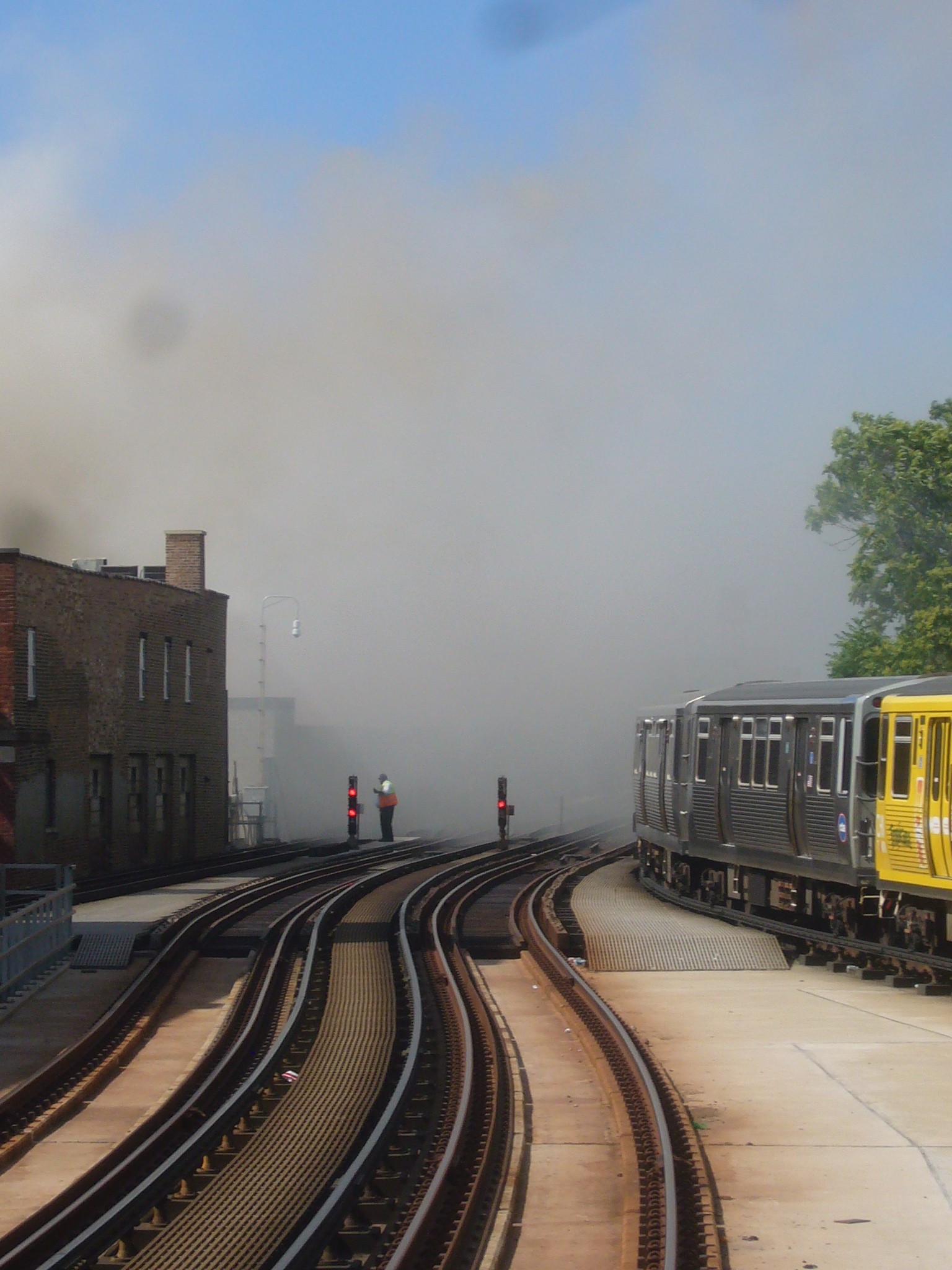
It’s not just CTA’s suboptimal management that causes passengers to be delayed. Fire yesterday just west of the Red Line near Altgeld, trains blocked for something like three hours. The train on Track 4 pulled back to Fullerton shortly after this photo.
After about twenty minutes it was clear service wouldn’t resume soon. A bus shuttle was promised, but downstairs there was just one empty bus labeled “not in service.” Even if buses were available, closure of Sheffield meant traffic was even more of a mess than usual.
So, a nice walk to Belmont, I do wonder how the CA there would have responded to a demand for free admission but as it happened I had a valid transfer and no CA was in sight anyway, just a lot of folks waiting for that mythical bus.
Can’t really blame CTA for this one, doubtless there’s plenty of blame for other agencies but I’m not privy to the details.
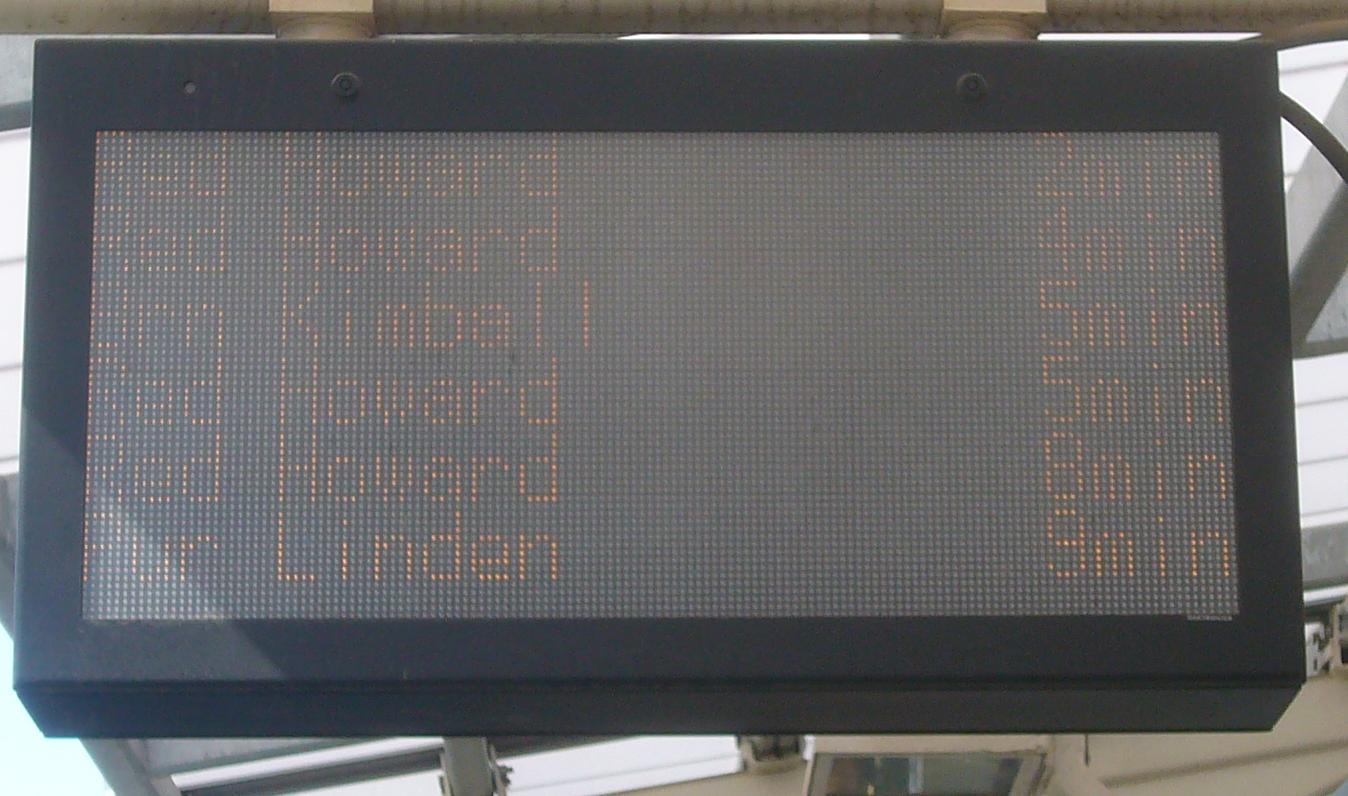
A three-hour delay didn't prevent the "information" display from promising six trains coming thru Fullerton in nine minutes.