Assessor ignores assessment policy

Last week, the Tribune published Cook County Assessor James Houlihan’s fiscal reform proposal.  He wants to restructure the state sales tax and the state income tax, claiming that this would not only balance the state budget but also provide more funds to localities, theoretically allowing them to reduce real estate taxes.

But Mr. Assessor, how about the assessment and extension of real estate taxes.  You know, the stuff you do?  Can’t you improve that?  Maybe you could start by assessing vacant land properly?  And making sure that land value is fully included in all assessments?  That’s not going to discourage any economic activity.

Then maybe we could ask the solons of the Cook County Board to change the property classification system, assessing improvements at only 40% of the ratio applied to land value? They could do this under existing law. Maybe they could even exempt improvements entirely?  And, while we’re asking the Illinois General Assembly to reform things, why not eliminate the sales and income taxes, by resurrecting the state sales tax?

Regular readers of this blog, and Henry George School students, know why this is a good idea.  Evidently Assessor Houlihan doesn’t want us to even think about it.
Earmarks

Wikipedia (right now) defines “earmark” as

a congressional provision that directs approved funds to be spent on specific projects or that directs specific exemptions from taxes or mandated fees.

On the face of it, I don’t see that as such a bad thing.  If my Congressbeing has determined that the national interest requires a particular expenditure, it seems reasonable that she might want to make sure that a budget or appropriation item really will be used for that purpose.

The problem, of course, has been that earmarks are obscure, and invariably are for local projects in which the Federal government has no legitimate role.  Now, the earmarks are being disclosed, at least by House members, and our friends at Taxpayers for Common Sense have compiled a list. Not of earmarks, but of URL’s where earmarks can be found.

I figured they might be bad, and they are.  “My” Congressbeing, for instance, has a list of mainly municipal and nonprofit projects, at least some of which are economically justified and therefore should be funded out of the savings or other benefits which they produce. There  are also a few government contractors being taken care of, and a couple of CTA projects.  Because the latter is something I know a little bit about, I can say that the descriptions are quite deceptive, greatly exaggerating the result (e.g. “extension of the Yellow Line”) which will be obtained by a relatively modest ($1 million) expenditure.

And that list is hardly the worst.

Does CPI show land price declines?

Of course the consumer price index, out this morning, doesn’t show land prices or land rents.  That is, cost of getting access to land is buried in all the other figures.

Much is being made of the year-to-year decline, which is largely due to the drop in petroleum (and gasoline) prices.  Of course this is reflected in housing costs, which include an energy component.  But the main piece of housing costs is “shelter cost.”  Under this, “rent” and “owner equivalent rent” increased 3.2% and 2.1%, respectively.  Because most Americans are “homeowners,”  the latter figure has a large impact on the total CPI.  The actual cost of purchasing a house and lot may have declined, but the CPI’s housing cost is based on what you might have to pay to rent a unit like the one you are buying.

The price of used cars also dropped, probably because fewer people are interested in buying one.  But the cost of what BLS calls “education” increased 5.6%.

For some reason BLS seems not to have yet posted the sub-national data.

What Crash? Cab Medallions STILL rising

Not as fast as previously, but the latest report on Chicago taxi medallions, from Chicago Dispatcher’s March issue, calculates a median price of $158,000.  This compares to $155,000 two months earlier.  Given the declines in the price of most other privileges over the last several months, this is a surprise, but perhaps the medallion market is slow to react.  Or perhaps there are other factors which improve medallion owners’ incomes in an economic recession?

This issue features the headline “Medallions in Jeopardy,” which had me hoping that perhaps this major obstacle to self-employment would be abolished.  But no, the article is about a particular case, where City administrators decided to punish the heirs of a deceased medallion owner, for whatever reason, by revoking the medallion on a technicality.  Chicago Dispatcher’s publisher, George Lutfallah, who wrote the article, evidently sees the medallions as assets for (some) existing cab drivers and others, rather than a barrier to non-owners struggling for a job.

How much fraud is there?

We have an estimate!

Fraud typically gobbles up around 7% of all big contracts.

This is from Watchdog Over Stimulus Spending Toes a Delicate Line, by Neil King, Jr., WSJ 3/9/09. Altho no source is cited, the implication is that this came from Earl Devaney, who according to the article heads the federal Recovery Act Accountability and Transparency Board.

I guess that’s just fraud.  Waste and inefficiency are things entirely different.

Arctic ice increasing…

… or so it would appear from this slashdot article.  ( The original source is here, but that link doesn’t appear permanent.)

The problem arose from a malfunction of the satellite sensor we use for our daily sea ice products. Upon further investigation, we discovered that starting around early January, an error known as sensor drift caused a slowly growing underestimation of Arctic sea ice extent. The underestimation reached approximately 500,000 square kilometers (193,000 square miles) by mid-February.

I would let our friends at Heartland Institute know about this, but apparently they’re still trying to figure out that California isn’t New Mexico. On January 29 I let them know of their error; as of February 19 it remains on their site.

Land Value vs. Land Rent

Altho Henry George’s proposal is “to abolish all taxation save that upon land values,” his objective really is to collect land rent for the community.  Of course land value is, ultimately, determined by anticipated land rent, but rent is more stable.

This is illustrated by a recent article in the Wall Street Journal (“Tax Break Divides Large, Small Builders,” Feb 11 ’09).   In an example cited as typical, Pulte Homes is reported to have sold, for $2 million, land they had “originally paid $28 million for.”  So if land value declined by over 92%, how much did land rent decline?

Probably quite a bit less than 92%, because the $28 million was based on Pulte’s guess as to what the future land rent would be.  The actual rent, the amount that someone would have paid to use the land at the time Pulte bought it,  was doubtless much less than their expectation of its future amount.

Some opponents of land value taxation cite cases of great declines in land prices to claim that LVT wouldn’t be a stable source of revenue.  But LVT moderates speculation, and land prices would be more stable if more of the land rent was collected for public use.

One illustration of this is that states where real estate tax is relatively high have experienced more stable prices for homes and lots.

You needn't mention Henry George…

…to be a Georgist. Michael Hudson’s analysis and forecast of bailout developments is helpful in understanding who benefits, and how it will be packaged to appear as homeowner aid.  One of his recommendations is clearly Georgist:

It is easy enough for fiscal policy to prevent a new real estate bubble. Simply shift the tax system back to where it originally was, on the land’s site-rental value. The “free lunch” (what John Stuart Mill called the “unearned increment” of rising land prices, a gain that landlords made “in their sleep”) would serve as the tax base instead of burdening labor and industry with income taxes and sales taxes. This would achieve the kind of free market that Adam Smith, John Stuart Mill and Alfred Marshall described, and which the Progressive Era aimed to achieve with America’s first income tax in 1913.

Hudson, like Kinsley and a few others, disdains the modern Georgist movement tho he seems to accept the validity and applicability of George’s (and modern Georgists’) analysis.

Thanks to Alanna Hartzok for the tip.

Another Chicago classic now available

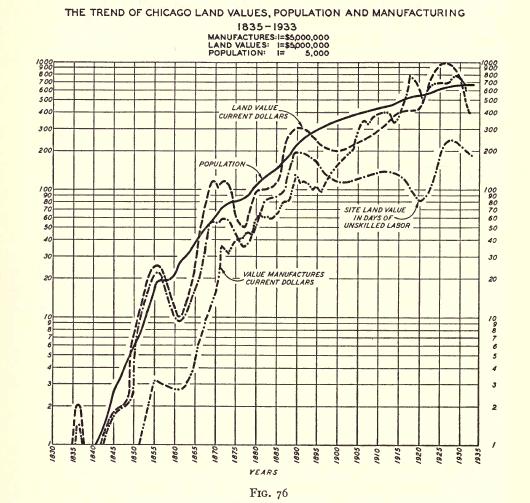
Homer Hoyt’s 1933 book “100 Years of Land value in Chicago” is now posted at the Internet Archive. Only a few land value nerds will read it all the way thru, but all should be impressed by the quantity of work Hoyt put into it, describing and analyzing Chicago’s land market for its first century.

Summary graph of land values

This was all done before cheap photocopiers, faxes, and of course computers. I wish someone would update it.