100% mortgages still available…

… at Prairie Park in Beecher, courtesy Uncle Sam. And, with the $8,000 credit Uncle also provides, you’ll take out some cash right away!

I guess the target market is folks who can’t save a few thousand dollars for a down payment. Or maybe the purpose is to keep some construction workers employed, builders solvent, and housing finance gangsters profitable. It’s a Department of Agriculture program, thus the houses are remote enough that any big increase in gasoline prices will be a problem.  (This DOA site indicates that 50,000 homes will be 100% financed, funded by the American Recovery and Reinvestment Act.)

I thought that, at least for a little while, the authorities would pretend to have learned the lesson, that poor people have better uses for their energy and money than becoming highly-leveraged “homeowners.” Silly me.

70 Senators agreed with Joe Stack

The main issue Joe Stack seemed to have with IRS when he crashed his plane into their offices yesterday was the “Section 1706” provision which made it difficult for “information technology professionals” to work as independent contractors. NY Times’ David Cay Johnston reports that 70 U S Senators, including original sponsor Moynihan, had agreed it raised little or no revenue and should be repealed, but somehow it survived.  Johnston also says it originated as a favor to IBM.

Is it inevitable that anything like a tax on earned income must become so complex that it virtually can’t be fixed, even when “everybody” agrees how it should be done?

Measuring the costs of political corruption

Trying to do some investment research, I got diverted to a couple of articles from the Review of Financial Studies.

In Corruption, Political Connections, and Municipal Finance, the authors assert that “Higher state corruption is associated with greater credit risk and higher bond yields.”  They apparently can measure the corruption and the cost; however the actual article is behind a paywall. I wonder if their results allow us to estimate how many dollars Illinoisans pay in higher debt service due to our political culture, or if the current estimate of “lots and lots” is sufficient.

Do Politically Connected Boards Affect Firm Value? might not seem to be a question worth asking, but it’s nice that academics have, they say, hand-classified corporate board members as “politically connected” to either of the two dominant U S parties. They find that nomination of a politically-connected individual to a board tends to increase stock prices, and that after the 2000 election, stocks associated with Republican boards went up, whereas those associated with Democrats went down.  Again, I cannot see the original article.

How corporate taxes caused the crash

Well, not entirely, but the deductibility of interest and the nondeductibility of dividends certainly encouraged corporations to borrow more than they otherwise would have.  Combined with tax incentives, interest payments were effectively subsidized more than 100%, as explained here.

Rentiers are welcome in the U S

Some Americans may not be aware that U S Citizenship– or at least, lawful permanent residency– has long been for sale, legally and aboveboard. It’s called the EB5 program, and essentially provides that any foreigner “investing” $500,000 to $1 million in a U. S. business can become a legal permanent resident.  And, of course, entrepreneurs have found the niche market, setting up businesses in which foreigners may invest, without taking an active role in management of the enterprise.

A Chinese and American joint venture is “converting the dormant Northridge mall in Milwaukee into a regional shopping center featuring merchandise from Chinese retailers” according to Milwaukee Business Journal.  Presumably, each of the 200 Chinese retailers expected could support one or more EB5 visas.  300-500 local residents are expected to be hired, tho I think it’s a bit imaginative to suggest that these jobs would be “created” by the project.  Rather, like most economic development incentives, they are simply shifted from elsewhere.

A China Daily report on the project indicates that the Chinese investors might not be familiar with primitive North American travel conditions.  Milwaukee “is only an hour away from Chicago,” says the developer. Maybe someday.

Of course, the poor would-be immigrant has no similar opportunity.  She cannot say “I will work to build a business that will employ Americans,” nor even “I will borrow a half-million dollars to invest,” as the program doesn’t permit this.

So, as existing Americans, are we better off inviting a bunch of rentiers, or a bunch of hardworking laborers?  Too many people believe that the latter will drive down American wages– which may appear to be true, only because we fail to consider what the immigrants can produce.

If we insist on inviting rentiers, we have chosen an inefficient way to do it.  Instead of requiring $500,000 invested in a business, when plenty of American entrepreneurs are already able to supply capital, we could simply require $500,000 paid toward reduction of the Federal debt.

Why campaign contribution limits can’t work

This is from House Banking Committee Chair Barney Frank, specifically on the subject of whether car dealers should be subject to regulation in regards to auto loans, but the significance is much more general:

“I have not had a problem because of campaign contributions. The problem is democracy: it’s people responding to people in their districts: community bankers, realtors, auto dealers, as I said, end users, insurance agents.”

“The local auto dealers are very popular in their districts,” Frank says. The more an interest group can make an issue district-specific and the more it can relate on an everyday level, Frank argues, the better it will do. “That’s why the realtors always beat the bankers. The bankers sit and they go [Frank makes a dour face, leans back in his chair and tightly folds his arms, miming an aloof posture]. The realtors are out there joining the Kiwanis and sponsoring little league.” The same is true with John Deere, dairy farmers and other back-slapping boys from back home.

How can we overcome this? Of course Realtors are going to support their own interests, ditto farmers [or, more likely, farmland owners], and other groups. One solution would be for us to treat government as a service administering common assets for the common benefit, rather than a means of transferring wealth to ourselves or our favorite groups.  Not easy, but at least it’s right.

Also relevant to this article, HGS students may remember this passage from Social Problems (1883).

The map of the United States is colored to show States and Territories. A map of real political powers would ignore State lines. Here would be a big patch representing the domains of Vanderbilt; there Jay Gould’s dominions would be brightly marked. In another place would be set off the empire of Stanford and Huntington; in another the newer empire of Henry Villard. The States and parts of States that own the sway of the Pennsylvania Central would be distinguished from those ruled by the Baltimore and Ohio; and so on. In our National Senate, sovereign members of the Union are supposed to be represented; but what are more truly represented are railroad kings and great moneyed interests, though occasionally a mine jobber from Nevada or Colorado, not inimical to the ruling powers, is suffered to buy himself a seat for glory.

Compare to this, from the  Huffpo article, Frank talking about his 71-member(!) committee:

“What’s happening now is the pro-regulation forces are being out-grassroots-ed by the antis,” Frank says. One member, he says, represented tons of title insurance companies. Another came from the headquarters of credit unions. A third’s district is home to LexisNexis; another to Equifax. Each of those entities received special treatment because their representative sits on the committee — and the more members on the committee, the more special treatment is needed.

HT, Felix Salmon

More bad news on seating

We have known for years that the new CTA railcars would have longitudinal seating.  Not particularly comfortable, but allegedly provides more standing room, and more wheelchair space.  A few new cars are now on the property and undergoing testing, so now we know that:

  • the new seats are the  regular substandard width, contoured kind, probably the least comfortable for bench seats;
  • the design fails to efficiently use even the limited space available.

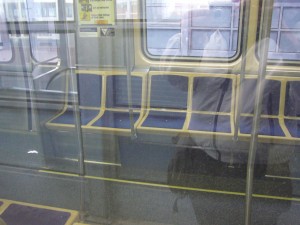
Regarding the latter point, if there is, say, an extra six inches in the space occupied by a row of, say, five seats, it is physically possible to space them an extra 1.5″ apart, providing a bit more space.  In fact, some CTA buses implement this concept on the rear bench.  But not the railcars.  The first pic illustrates this.
making a bad situation worse

One wonders what is expected to happen in the several extra inches at the end of the car.

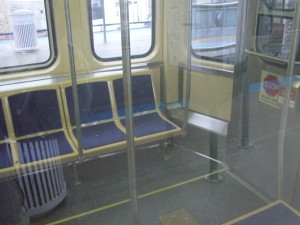
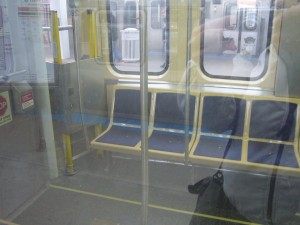
Below are a couple more pics. These were taken yesterday at Howard, where a test train paused briefly at the platform. Sorry about the poor quality (of the images); they were taken thru thehigh-reflectivity glass used on these cars.

what your tax money buys
your tax dollars

Even if they operate well (of which there is no guarantee), it is evident that these are the most uncomfortable cars yet.  Unfortunately, the same has been said about every car order since at least 1972, and it is all too likely that captive riders will become accustomed, and the few noncaptives will depart.  (Or be made captive by decreasing incomes and increasing parking costs).

Crash recovery manual

After the Crash: Designing a Depression-Free Economy.  By Mason Gaffney, edited and with an intro by Cliff Cobb. Published by Robert Schalkenbach Foundation, 2009.

From time to time, a Georgist will suggest to me that one or another politician or academic, who seems sympathetic but ignorant about economics, should be given a copy of Progress & Poverty.  I usually reply that such persons are too famous and wise to be influenced by new ideas or logical analysis.  But now I might propose that, if one is serious about promoting wise economic policy, one might make the investment to give such a distinguished person After the Crash.

Georgists know that the crash could have been avoided by a simple policy of taxing privilege, not production.  But here we are, in a real economy which is doing poorly.  Mason Gaffney explains how we got here, and what needs to be done to get us out. Everyone who wants to understand the situation should read this book.  It is as long as it needs to be– a bit over 200 pages– and doesn’t seem to be available on the free Internet, so unfortunately some of the most vocal advocates won’t read it. Wealthy institutions– Lincoln, Cato, New America, EPI, etc.– could do no better service than to buy whatever rights are necessary to make it widely available.

Although it is listed on Amazon, Schalkenbach seems to offer a much better price.

Here are what appear to be the main points.

1. Speculation in land titles, and other types of privilege, was the main cause of the crash.  It was made more severe because banks and similar institutions financed it liberally.

2. For a job-rich recovery, we need to recognize that some types of capital investment create a lot more jobs than others. The best type of investment for this purpose turns over rapidly. Compare the number of jobs generated by a major infrastructure project— high speed rail, for instance— with the same amount of money invested by small scale businesses in working capital for inventory and payroll. Done properly, this analysis needs to cover the entire time period while the infrastructure project is amortized.

3. Current government policy at all levels focuses mainly on big projects that generate few jobs per million dollars invested.  This involves not only direct government investment, but tax laws and other practices that favor these kinds of investments.  One reason for this is that the beneficiaries– banks and monopolies– have the resources to lobby effectively.

4. Wise policy is to eliminate such programs, but not to create new ones subsidizing job-creating investments.  Rather, if we just let the market function, without taxing labor to subsidize the privileged, the recovery will be faster, broader, and more stable.

5. The “property” (real estate) tax has much better economic effects than income taxes or consumption taxes.  Even though it penalizes building construction, the effect is to channel more investment away from job-poor and into job-rich forms.

6. Banks have repeatedly got into trouble by lending on real estate, with the current crash only the most recent example.  Wise policy would insist that banks make mainly “self-liquidating” loans, such as for inventory or accounts receivable, and require that real estate purchasers provide hefty equity.

There is much much more in this book, and I started to write a much longer review, but will not complete it because no one (including me) would have the stamina to read it.  I will post some pieces of it later. Meanwhile, if you are concerned about our economic future, you should read this book.
Speculation in an empty city

At Ordos, China, local officials reportedly have built an entire new city for a million people.  But no one can move there, because all the apartments have been bought by speculators so housing is too expensive.  Al Jazeera seems to be the only real source for this story, tho brief mentions (omitting speculation) are in the Telegraph and National Post , and of course numerous blogs link to the video.

Easier TIF qualification

Now you don’t need to even pretend that your TIF area is dilapidated. Just propose a STAR Line station within a half mile, get the Board to approve, and you can divert tax dollars pretty much for whatever you want. Thanks to ILAPA’s Sharon Caddigan for the alert.  Of course, an openly-administered TIF process might be appropriate for development near any transit station, provided that the funds raised are used to actually provide service at the station.